6 Best Multi-Stop Route Planner Apps for 2026

Google Maps isn't built for multi-stop routes. We tested 6 specialist apps to match different needs: One free option, plus solutions for delivery drivers, sales reps, field service techs, and outdoor adventures.

- Google Maps isn't built for multi-stop planning: Specialist apps with route optimization work better.
- Free options exist but have limits: RouteXL allows 20 stops per route, while most free apps cap at 10.
- Choose apps for your specific needs: Delivery routes need different features than sales calls or hiking trails.
- Route optimization saves time and money: Apps automatically sort stops into the most efficient order.
- Most professional apps cost $10-35/month, but the fuel and time savings usually justify the cost.
- Mobile vs web matters: Some apps work better on desktop for planning, mobile for navigation.
- We tested 6 top-rated solutions including basic route planners, delivery management platforms, and outdoor activity planners.
Navigation apps like Google Maps, Waze, and Apple Maps are great at getting you from A to B. But what happens when you need to keep moving from B to C, D, E, F, and beyond? That's multi-stop route planning — and navigation apps are really bad at it. You can add multiple destinations, then change their order by dragging addresses up and down the list. But it's slow and inefficient, and there are better solutions.
The truth is, multi-stop route planning is advanced functionality that needs specialist apps with route optimization. Route planners that are fine-tuned for a particular task, like deliveries or running routes, often work best.
This article shares the best apps for six different situations:
- Free web-based route planner: RouteXL
- Last-mile deliveries: Routific
- Solo delivery drivers: Spoke Route Planner
- Sales reps: SalesRabbit
- Service techs: Optimoroute
- Outdoor adventures: AllTrails
💡There's only one free route planner in this article. If it's specifically a FREE app you need, check out our article on the best free route planners.
Six multi-stop route planner apps to take the pain out of planning
1. Best free web-based route planner: RouteXL
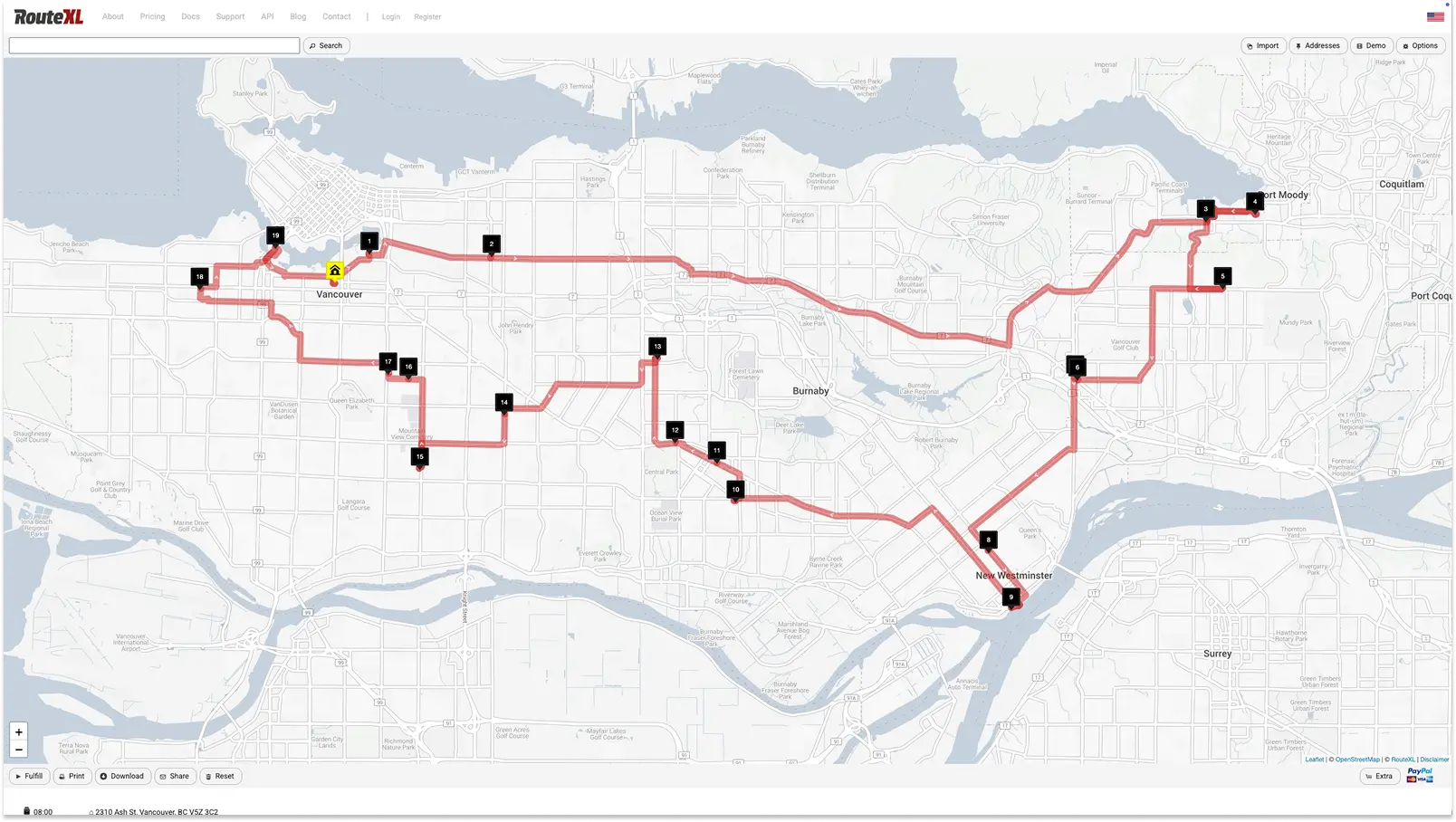
RouteXL is excellent free route mapping software for occasional users. It could even be a good basic planner for a road trip. Here's how it works:
- Add up to 20 addresses by copying and pasting from an Excel spreadsheet or CSV file.
- Click “Find route” to optimize.
- Share your optimized route to a navigation app like TomTom, or send via email or Whatsapp to open it on your phone.
Advantages
- No ad clutter on the map — unlike MapQuest and Google Maps.
- Optimize up to 20 stops per route in the free version. (Paid packages allow up to 100 or 200 stops per route.)
- You can create multiple routes each day. The number of stops on each free route is still limited to 20, but you can combine these if necessary.
- You can add notes to your stops.
- It’s easy to look up charging stations near each stop.
Disadvantages
- You can’t look up an address just using the name of a business or location. You will need an actual street address.
- RouteXL can be very slow. This is not a problem if you’re an occasional user, but if you need it every day to run a small business, you may find it frustrating.
- There’s no mobile app. When you send a RouteXL route to your phone, it will open in a web browser as a list of stops. For navigation, use Apple Maps or Google Maps, depending on your phone.
Pricing
If you want to plan more than 26 stops with RouteXL, you need to buy credits. There are two pricing tiers:
- Up to 100 stops per route: €5 per day or €35 per month.
- Up to 200 stops per route: €10 per day or €70 per month.
2. Best for last-mile delivery route planning: Routific

Delivery companies need more than just optimized routes and driving directions. They need to be able to track their drivers, notify customers about the progress of their deliveries, collect proof of delivery, and manage their costs.
Routific’s user-friendly route optimization software does all that, while enabling last mile delivery companies to slash delivery costs and travel time by up to 25%. Intelligent route optimization and traffic pattern-based algorithms enable fast and efficient deliveries.
The combination of a web planning interface and a free mobile driver app makes it easy to connect drivers and dispatchers, so managers can track delivery progress in real-time, review stats, and better manage their delivery operations.
Routific helps delivery business:
- Deliver on time.
- Reduce delivery costs by as much as 25%.
- Delight their customers.
Advantages
- Easily plan and edit delivery driver routes and schedules.
- Live GPS and progress tracking.
- End-of-day reports are available to monitor driver performance.
- Automate customer notifications.
Disadvantages
- Doesn’t have barcode scanning
- No in-app chat function
Pricing
Routific’s freemium pricing model is based on the number of orders scheduled.
- The first 100 orders every month are free, to accommodate the needs of very small businesses, non-profits, and occasional users.
- 100-1,000 orders: $150 a month.
- Above 1,000 orders we charge a few cents per stop. Pricing starts at 15c a stop up to 2,000 orders a month, going down to 3c a stop for more than 20,000 orders a month.
💡Try Routific for free — no credit card needed.
Alternative route planners for delivery businesses
- Onfleet: Less easy to use than Routific and the route optimization isn’t as good, but does have features we lack like barcode scanning and age verification.
- Optimoroute: We recommend Optimoroute for field service techs (see below), but it also does delivery route planning. Routific has better route optimization, though.
3. Best mobile app for solo delivery drivers: Spoke Route Planner

Spoke is a route optimization app that can streamline your day as a trucker or delivery driver. Just enter your stops — you can even scan in a printed manifest — and Spoke Route Planner will generate the best route. When you’re ready to hit the road, the app will send driving directions right to your favorite navigation app.
With Spoke, you can even add breaks to your routes to ensure your ETAs are always accurate. You can:
- Prioritize certain stops and set delivery time windows for each one.
- Add, delete, or re-optimize routes while you’re out on your route.
- Scan address labels with your smartphone to add stops.
If you’re using an Android device, you can also upload your stops via spreadsheet.
Advantages
- Add and optimize unlimited stops.
- Easy to manually re-order routes when necessary.
- Use the “load vehicle” feature to note exactly where in your vehicle each package is loaded.
Disadvantages
- Spreadsheet importing is only available with the Premium tier.
- The free tier only offers 10 stops per day. After that, it’s US$20 a month.
Pricing
Spoke has three pricing tiers:
- Free: Up to 10 stops per route
- Lite: $10 per month. Unlimited stops, but other features are very limited.
- Standard: $20 per month. Unlimited stops, add stops by voice or camera, Package Finder.
Alternative route planners for solo delivery drivers
- Hammer: A free navigation and routing app designed for large commercial vehicles. Routes are tailored to your truck type, and the app helps you avoid low bridge clearances and truck restrictions.
- RoadWarrior: Similar to Spoke, but routes are limited to 200 stops. Route planning and optimization are quick and easy.
4. Best for field sales reps: SalesRabbit

SalesRabbit is specifically designed for sales teams, so there’s much more to it than a route planner. The SalesRabbit platform includes apps for appointment scheduling, mobile contracts, training, and more. But their route planner is included in their free Lite version, available on Android and iOS devices.
Sales reps will appreciate the platform’s:
- Ability to optimize routes based on sales appointment times.
- Ease of adding up to 23 leads to the map.
- Smart labeling so that sales reps can see the lead’s name and appointment time at a glance.
- Canvassing options to monitor progress, assign areas for teams, and review past performance data for the area.
Advantages
- Free route planning allows users to try the platform before committing to a paid tier.
- Extensive lead information is available for each stop, enabling sales reps to know what to expect when knocking on the lead’s door or walking into their office.
- Advanced tiers offer scheduling, weather alerts, reports, advanced canvassing, import from Excel and other formats, and more.
Disadvantages
- You need to create an account, even if you’re using the free Lite version of SalesRabbit.
- Free users are restricted to the mobile app. The web app is only available on paid tiers.
Pricing
SalesRabbit has four pricing tiers, including a free option:
- Lite: Free, includes basic route planning. One user only.
- Team: $59 per month. Up to five users.
- Pro: $75 per month, or $49 a month if you pay annually. Up to 50 users.
- Enterprise: Contact them for a customized demo and estimate.
Alternative route planners for sales reps
- Badger Maps: Fast, speedy route optimization with capabilities to optimize 100+ stops effortlessly, and to identify opportunities near your current location.
- RepMove: Territory management, shared customer data, and optimized sales routes to minimize travel time.
5. Best for field service techs: OptimoRoute
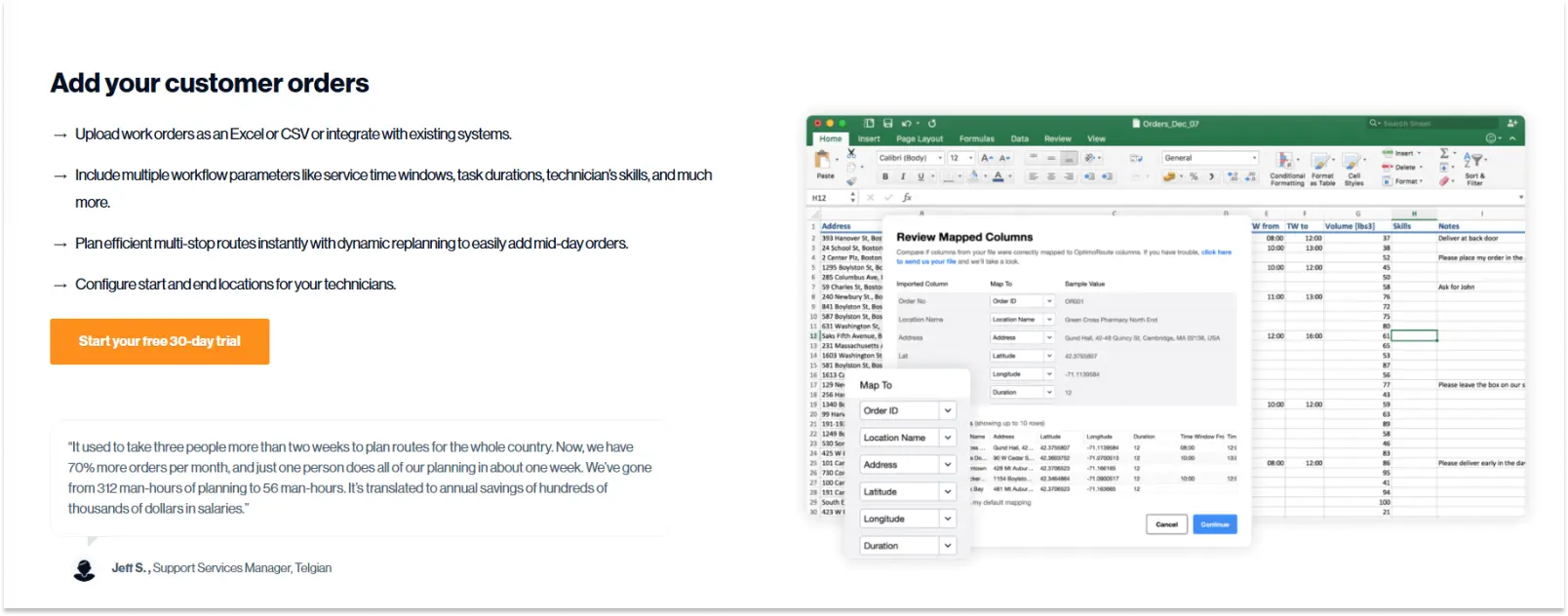
OptimoRoute is a versatile route planner for many different use cases, including deliveries and long-haul routes — but it’s particularly good for field service techs. With OptimoRoute, technicians can find the best route around their different service stops, to save time and money while providing customers with real-time ETAs.
If you have a large database of customers, automated planning allows you to import thousands of orders, and the platform will select the most efficient route.
You can:
- Add workflow constraints and vehicle details to enhance arrival times.
- Automatically match the right skills and tools to each job.
- Include workflow parameters like service time windows and task durations.
Advantages
- Proof of delivery or job completion.
- Live tracking and ETA options.
- Native apps for iPhone and Android devices.
Disadvantages
- Recurring stops are not supported well, and there is no easy way to see past services.
- Updates to the app can remove random stops.
Pricing
If you sign up for a full year, OptimoRoute’s pricing tiers are:
- Lite: $35.10 per driver per month with a limit of 700 orders.
- Pro: $44.10 per month for up to 1,000 orders, real-time tracking and proof of delivery.
- Custom: Contact them to get pricing for more complex needs.
OptimoRoute offers a generous 30-day free trial, but the trial is limited to 250 stops so it’s hard to assess how performance will scale.
Alternative route planners for field service techs
- MyWay: A trusted route planner for 600k drivers across 150 countries with the power to optimize 200 stops at once.
- Maptive: A free multi-stop route planner with real-time updates via API access, customizable maps, driving radius maps, and more.
6. Best for planning outdoor activities: AllTrails
Planning routes for recreational activities like hikes, trail runs, or bike trips is a special case. When I’m planning a run or hike, my goal is not the most efficient route — I care more about distance, elevation profile, safety, and how good the overall trail experience is. A navigation app designed for drivers will only get me as far as the trailhead parking.
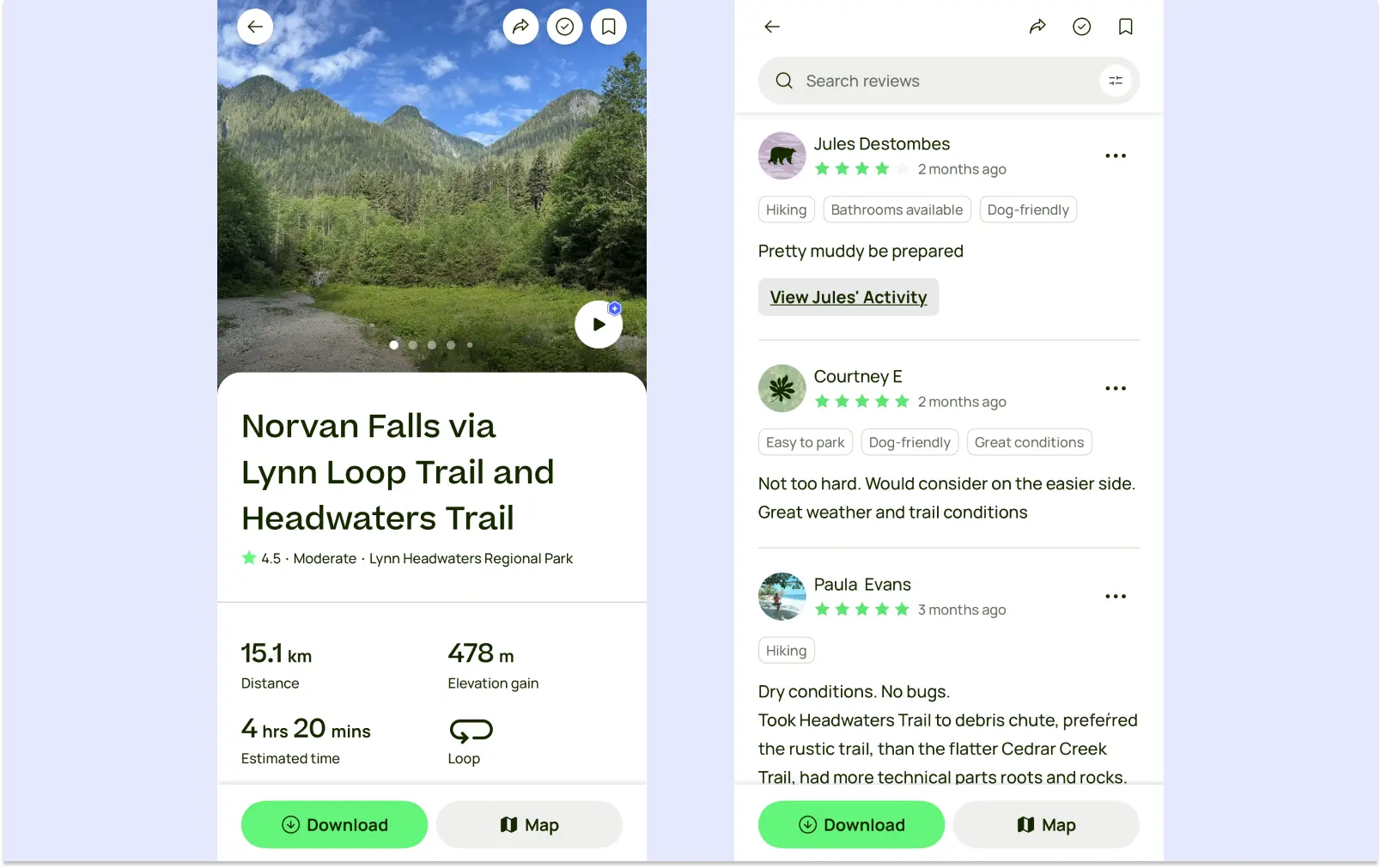
There are lots of apps to help plan the best route for outdoor activities, but AllTrails stands apart. Its biggest asset is its massive, regularly updated database of user-reviewed trails and robust route planning features.
I have a personal subscription to AllTrails, and I don’t plan a hike without consulting the latest trip reports. Trail conditions can change fast after storms, snowfalls, and between seasons, and recent user reports make it much easier to choose a trail that will be fun and safe.
You can start exploring trails immediately without an account, though you’ll need one to save routes and access offline maps on your mobile device.
AllTrails offers:
- Detailed trail information including difficulty, elevation gain, and current conditions.
- Crowd-sourced updates about trail conditions and hazards.
- Custom route creation with unlimited waypoints.
- The ability to download maps for offline use (Pro feature).
- 3D trail previews so it’s easy to see elevation changes (Pro feature).
Advantages
- Large database of user-verified trails with recent reviews and photos.
- Filter routes by difficulty, length, elevation gain, and features.
- Includes wheelchair-friendly and dog-friendly routes.
- Safety features like wrong-turn alerts and off-route notifications (Pro).
Disadvantages
- Many key features (offline maps, wrong-turn alerts) require Pro subscription.
- Mobile route planning interface can be clunky — desktop works better.
Pricing
AllTrails has two pricing tiers:
- Base: Free. Save trails and navigate only.
- Plus: $35.99 a year. Save maps for offline use.
Alternative route planners for outdoor adventures
- Komoot: Stronger focus on cycling routes with excellent turn-by-turn navigation.
- Outdoor Active: More activity options including horse riding and winter sports.
- Gaia GPS: More detailed topographic maps and advanced navigation features for serious backcountry users.
- Bikemap: Designed just for biking, with pre-planned and custom routes available.
- Plotaroute: Offers multiple options for route planning, including auto-generated plans, point-and-click, waypoints, or route upload.
Is there a free mobile route planner with multiple stops?
We’re always looking for a mobile app that gives free, easy, optimized driving directions for multi-stop routes. We haven’t found one yet. It turns out that route optimization is an expensive service to provide.
Sure, if you search the App Store or Google Play you’ll find plenty of apps that advertise themselves as multi-stop route planners. But all of them have one of these problems:
- Most apps don’t do anything different or better than Google Maps, Apple Maps or HERE WeGO. You can add a bunch of addresses, but you will need to change the order of stops yourself to find the shortest route. This goes for apps like MapQuest and MyRouteOnline.
- Some apps create optimized routes, but don’t let you use them unless you sign up for a paid account. This happened with apps like Route4Me and Zeo — they’re aiming at a commercial market.
Until someone finds a way to make a free multi-stop route planner app worthwhile, you’re stuck with RouteXL: Plan on desktop, get driving directions on mobile.
Multi-stop route planning made easy
Planning a multi-stop route doesn’t have to be complicated. These apps streamline the process to save you time and serious headaches. While I’ve chosen a “best use” for each of these apps, most are versatile enough to be used for a variety of route planning purposes and for driving directions.
Frequently Asked Questions
What is multi-stop route planning?

Multi-stop route planning is the process of finding the most efficient order to visit multiple locations. Standard navigation apps like Google Maps can give you directions between stops, but they don't optimize the sequence — you have to drag stops into order manually. Multi-stop route planning apps solve this by automatically calculating the fastest overall route, accounting for factors like distance, traffic patterns, and time windows. This is especially valuable for delivery drivers, sales reps, and service technicians who visit many locations per day.
What is the best multi-stop route planner app?
It depends on what you're planning. For delivery businesses managing multiple drivers, Routific offers the best route optimization with built-in dispatch, tracking, and customer notifications. For solo delivery drivers, Spoke Route Planner (formerly Circuit) is a popular mobile app. For occasional personal use, RouteXL is free. For field sales, SalesRabbit and Badger Maps combine route planning with CRM features. For outdoor activities, AllTrails is the go-to for hiking and trail running routes.
Is there a free multi-stop route planner?
Yes, but free tools have stop limits. RouteXL optimizes up to 20 stops for free on the web. For mobile, Spoke Route Planner (formerly Circuit) offers 10 free stops per day, and SoloRoute Mobile handles 20. None of these free tools include delivery management features like tracking or customer notifications — for that, you'll need paid software. See our full guide to free route planners.
What’s the difference between Google Maps and a route optimizer?
Google Maps is a navigation app. It:
- Shows the fastest route between two points
- Gives turn-by-turn driving directions
- Has excellent real-time traffic data
- Supports up to 10 stops, but doesn’t optimize their order
A route optimizer is planning software. It:
- Finds the most efficient sequence for visiting multiple stops
- Handles 20-100+ stops (depending on the tool)
- Focuses on stop order, not driving directions
- Usually exports to Google Maps or similar apps for actual navigation
Think of it this way: A route optimizer tells you which order to visit your stops. Then you use Google Maps to actually drive the route with turn-by-turn directions.
Do I need to pay for route optimization?
Basic route optimization is free. Tools like SoloRoute Web, RouteXL, and MapQuest handle up to 20-26 stops with automated optimization.
You will need paid software when:
- You have more than 25 stops per route.
- You need time windows (“arrive between 2-4pm”).
- You’re planning routes for multiple drivers.
- You need features like live tracking, proof of delivery, or customer notifications.
- You’re planning routes daily (time savings justify the cost).
For small businesses doing occasional deliveries, free tools are usually good enough. For more sophisticated delivery operations, paid route optimization software typically pays for itself quickly through time and fuel savings.

The Best Mobile Route Planning Apps for Delivery Drivers

Google Maps Route Planner: How To Plan Multi-Stop Routes