
The Case for Staying Small: How Permaculture Thinking Built a Sustainable Kombucha Business

Why one kombucha maker resists pressure to scale — and how permaculture principles guide business decisions most founders never question.
- Staying small is a viable strategy: Resisting pressure to scale preserves work-life balance and reduces risk.
- Diversify revenue, not production: Multiple streams (wholesale, subscriptions, workshops, mobile bar) create stability without requiring bigger equipment or more staff.
- Not every constraint is a problem: Equipment limits and small-town hiring set the limits of a sustainable pace — fighting them isn't always the answer.
- Grow through relationships, not marketing: Existing community ties and direct outreach drive growth more reliably than ad spend.
- Turn waste into options: Byproducts like apple slices and old SCOBYs become experiments that may graduate into products.
- Rural base, urban reach: Low small-town overhead enables profitable delivery to nearby cities with optimized routes from Routific.
Sebastien Armand's path to kombucha started in gardens, not kitchens.
“I learned gardening from some elders I met 30 years ago — they had survived cancer and were convinced of the value of food as medicine,” he says. “We created a community-supported agriculture scheme and I ran that for a while. Then I lived and worked in Argentina, Costa Rica, and Turkey.”
During those years, Sebastien studied permaculture with some of the movement's pioneers, including Bill Mollison, Geoff Lawton, and Sepp Holzer. The principles he learned — working with natural systems rather than against them, building diversity for resilience, turning waste into input — would later shape how he runs a business.
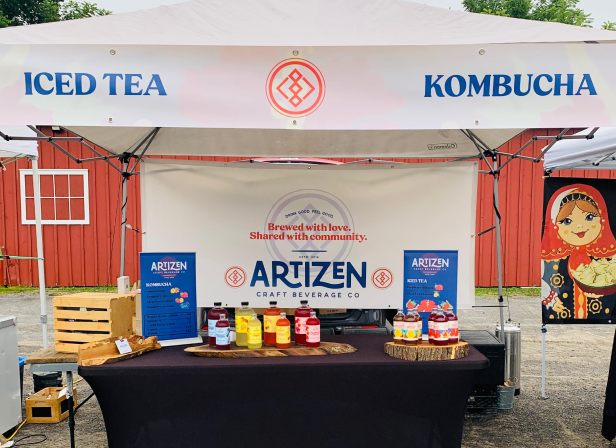
Today, Artizen Craft Beverage Co. operates out of Perth, Ontario, a small town halfway between Ottawa and Kingston. Twelve 300-litre fermentation tanks line the production room, each holding kombucha at various stages of a three-week cycle. The operation produces 2,000 litres a week, bottled and delivered to around 60 wholesale accounts — health stores, cafes, restaurants, yoga studios — across the Ottawa-Kingston corridor.
It's a thriving small business. And Sebastien intends to keep it that way.
“We're comfortable at our current scale”
Every small food producer hears the same message: scale up or get left behind. Distributors push for higher volumes. Business advice assumes growth is the goal. The success stories that get published celebrate companies that started small and got big.
Sebastien has heard it all. Distributors have made clear they'd love him to expand production. His position is equally clear.
“We're comfortable at our current scale,” he says. “We have three kids in school, and this allows us a great balance between work and family.”
The business has hit the limit of its current bottling machine, which still requires significant human supervision. Expanding capacity would mean a major equipment investment and hiring more people — already difficult in a small town. But even if those constraints disappeared, Sebastien questions whether rapid scaling would serve his actual goals.
“Would we scale? I think I'd rather diversify.”
That's not a temporary pause or a failure of ambition. It's permaculture thinking applied to business.
Diversity is safety

“Diversity is safety,” Sebastien says. “I would not want to do only one thing.”
In an ecosystem, monocultures are fragile. A single pest or disease can devastate an entire crop. Sebastien sees the same vulnerability in businesses that depend on one revenue stream or one big customer. So instead of scaling production, Artizen has built multiple ways to generate income:
Wholesale forms the core business — roughly 60 accounts ordering on relatively predictable cycles. Cafes, restaurants, health stores, yoga studios. Pizza restaurants have proven surprisingly strong. “People like the kombucha to help them digest,” Sebastien says.
Online retail and subscriptions serve direct customers. Everything Artizen makes is available on their website, and they sell at farmers markets and seasonal markets throughout the region. Subscription customers get access to exclusive flavor profiles unavailable at retail — building loyalty without requiring separate production runs.
Kombucha workshops happen during winter downtime, when production slows. Up to 10 people learn about tea culture and fermentation science, then go home with 4 litres of starter and a SCOBY. “One reason I do workshops is that I want everyone to be able to make kombucha,” Sebastien says. “I don't mind when people start out on their own.”
Mobile bar service captures event revenue — high-margin when it happens, and good for brand awareness even when it doesn't.
Each stream serves different needs. Wholesale provides baseline stability. Subscriptions build direct relationships. Workshops fill slower months and educate the market. Events capture upside. No single channel failing would sink the business.
From one litre to 2,000 litres

Artizen didn't start with 12 fermentation tanks and 60 wholesale accounts. It started with one litre of kombucha, a co-op kitchen, and a table at the farmers market.
When Sebastien and his former partner Dasha Smolentseva moved to Perth, they wanted land to raise a family and grow food. Fermentation experiments came later — kombucha, bone broth, kale chips, whatever they could test on market customers.
Early production ran out of a shared kitchen at the Two Rivers Food Hub in nearby Smiths Falls. Grant funding, loans, and mentorship from Valley Heartland Community Futures Development Corporation helped finance gradual equipment upgrades. One litre became 20, then 50, then today's bank of 300-litre tanks.
“Use small and slow solutions” is another permaculture principle. Sebastien applied it to capital investment the same way he'd apply it to garden design — each step deliberate, each expansion earned.
Today, with Dasha running her own separate business, the North Folk Cafe and Bakery in downtown Perth, Artizen is a four-person operation. That's enough.
Growing through relationships

Artizen's first wholesale customer was a health store Sebastien and Dasha had visited for years. The relationship already existed. The store was willing to try their product.
This pattern has defined their growth ever since.
“We'll literally knock on the door of a health store and drop off some samples,” Sebastien says.
There's an Instagram account, but no ad spend or influencer campaigns. Growth comes from direct relationships built on quality product and personal connection. A couple of small distributors extend their reach into stores they wouldn't otherwise access — sometimes even Sebastien is surprised where their product turns up — but the engine is fundamentally relational.
Some customers have been buying cases of kombucha every two weeks for a decade. That kind of loyalty doesn't come from marketing. It comes from showing up consistently, year after year.
“The biggest surprise has been the support,” Sebastien says. “We get such great direct feedback from our customers.”
Waste becomes product
Apple pulp left over from apple cinnamon kombucha becomes apple chips. Old SCOBYs — the rubbery cultures that ferment the tea — get blended with fruit to make rollups. Mixed with glycerin and lye, they can become vegan leather.
“I'm always experimenting,” Sebastien says.
None of these byproducts are commercialized yet. They go to friends and farmers markets, tested informally before any commitment to full production. But they demonstrate how zero-waste thinking — another permaculture principle — creates options without requiring scale.
The recently introduced iced tea line started the same way. Experiments that worked graduated into the permanent offering. Those that didn't became learning rather than loss.
Efficient delivery as the business grew
When Artizen had just a handful of delivery customers, route planning was simple: load addresses into Google Maps, do some basic rearrangement, hit the road.
But wholesale customers don't all need product on the same schedule. Some turn over stock weekly; others every two or three weeks. As the customer base grew to 25-30 stops weekly, manual planning became a time sink — and routes changed week to week based on who actually needed a delivery.
“We found Routific when we moved up to doing 25-30 deliveries,“ Sebastien explains. “It saves lots of time and energy.”
Route optimization software handles the variability automatically. The time that used to go into planning now goes into production, sales, or — because the business is designed for it — family.
💡 The efficiency threshold: Manual route planning typically breaks down around 15-20 regular stops. Beyond that, planning time starts eating into time better spent elsewhere. Routific helps small producers reclaim those hours. Start your free trial.
Rural location, urban reach
Perth isn't a major market. It's a small town. But Artizen serves customers in Ottawa and Kingston — cities 80-100 km away.
“The biggest factor if we operated in a city would be rent,” Sebastien explains. “In Perth our costs are low.”
They share production space with another company, keeping overhead minimal. The savings more than offset delivery costs, especially with optimized routes keeping those runs tight. For a production schedule measured in weekly batches rather than daily runs, rural-base-urban-delivery works — maybe even better than locating where customers are and paying city rent.
Co-opetition
Sebastien uses the term “co-opetition” — cooperation with competitors for mutual benefit.
The workshops are part of this philosophy. So were the gatherings he and Dasha used to organize for regional kombucha producers, where they'd share knowledge and discuss common challenges. Of the original group, only Artizen and one other company are still operating. The rest moved on to other things.
Why train people who might become competitors?
“I believe that a more educated market benefits established producers,“ Sebastien says. “People who understand kombucha appreciate quality. Home fermenters become evangelists. New producers who survive improve the category's reputation.”
The rising tide lifts the boats that are seaworthy.
What “sustainable” actually means
The word gets thrown around loosely. For Artizen, it has specific dimensions:
The business generates enough revenue to pay fair wages, cover costs, and leave something for the family — without outside investment or debt-fueled growth. Sebastien and his family aren't burning out, even with three kids in school and lots of activities. The operation runs at a pace the team and equipment can actually handle, with no scramble to hire faster than they can train. Customer relationships are measured in years, not transactions.
Most growth-focused businesses sacrifice at least one of these dimensions to achieve scale. Artizen's bet is that preserving all of them creates a different kind of value — one that doesn't show up in revenue growth but shows up in everything else.
Questions worth asking
Artizen's approach won't fit every business or every founder. Some people genuinely want to build large organizations. Some markets reward scale in ways that make staying small uncompetitive.
But for craft producers in local and regional markets — kombucha, coffee, specialty foods, craft beverages — Sebastien’s story raises questions worth sitting with:
- What are you actually optimizing for? Revenue growth? Profit margin? Time freedom? Creative satisfaction? Community impact? Different answers lead to different strategies.
- What would “enough” look like — not as a temporary milestone, but as a design target?
- Are your constraints actually problems? Or are they information about sustainable pace?
- What would diversification look like? Could you add revenue streams that don't require scaling production?
- What's the actual cost of growth — not just financial, but time, stress, complexity, and risk?
“Permaculture taught me the importance of working with nature, not only in the garden but in the family and in business,” Sebastien says.
For founders who've internalized “grow or die” as unquestionable truth, that's a different way of thinking. It doesn't reject success. It redefines it.
Frequently Asked Questions
What's the best delivery software for small beverage producers?

Small kombucha, beer, and other craft beverage producers typically need route optimization software once they exceed 15-20 regular delivery stops. Manual planning with Google Maps works for simple routes but becomes an inefficient time sink as complexity grows. Routific is an excellent option for breweries and beverage producers that have grown past 25-30 stops a week. Artizen Craft Beverage Co., for example, says using Routific “saves lots of time and energy.“
How is route optimization different from Google Maps?
Google Maps navigates between points but doesn't optimize stop sequence. Route optimization software like Routific calculates the most efficient order for all stops, accounting for time windows, vehicle capacity, and delivery priorities. For a beverage producer with 30+ accounts, this typically saves hours of planning weekly and reduces drive time 20-40% compared to manually sequenced routes.

Best Route Planning Software For Delivery Businesses in 2026

Next-day Delivery Helps Greenhouse Juice Grow

