'%3E%3Cpath id='Hexagon top left' d='M4.13 4.66C4.20 4.40 4.40 4.20 4.66 4.13L11.85 2.20C12.11 2.13 12.39 2.20 12.57 2.39L17.84 7.66C18.03 7.85 18.10 8.13 18.03 8.38L15.99 16L8.38 18.03C8.13 18.10 7.85 18.03 7.66 17.84L2.39 12.57C2.20 12.39 2.13 12.11 2.20 11.85L4.13 4.66Z' fill='%23FFAD0A'/%3E%3Cpath id='Hexagon bottom right' d='M16.00 16.00L23.61 13.96C23.87 13.89 24.14 13.96 24.33 14.15L29.60 19.42C29.79 19.60 29.86 19.88 29.79 20.14L27.86 27.33C27.79 27.59 27.59 27.79 27.33 27.86L20.14 29.79C19.88 29.86 19.61 29.79 19.42 29.60L14.15 24.33C13.96 24.14 13.89 23.87 13.96 23.61L16.00 16.00Z' fill='%23FFAD0A'/%3E%3Cpath id='Hexagon bottom left' d='M15.99 16.00L18.03 23.61C18.10 23.87 18.03 24.14 17.84 24.33L12.57 29.60C12.39 29.79 12.11 29.86 11.85 29.79L4.66 27.86C4.40 27.79 4.20 27.59 4.13 27.33L2.20 20.14C2.13 19.88 2.20 19.60 2.39 19.42L7.66 14.15C7.85 13.96 8.13 13.89 8.38 13.96L15.99 16.00Z' fill='%23374CD2'/%3E%3Cpath id='Hexagon top right' d='M27.33 4.13C27.59 4.20 27.79 4.40 27.86 4.66L29.79 11.85C29.86 12.11 29.79 12.39 29.60 12.57L24.33 17.84C24.14 18.03 23.87 18.10 23.61 18.03L16.00 16L13.96 8.38C13.89 8.13 13.96 7.85 14.15 7.66L19.42 2.39C19.61 2.20 19.88 2.13 20.14 2.20L27.33 4.13Z' fill='%23374CD2'/%3E%3Cpath id='Diamond top' opacity='0.75' d='M14.15 7.66L16 5.82L17.84 7.66C18.03 7.85 18.10 8.13 18.03 8.38L16 16L13.96 8.39C13.89 8.13 13.96 7.85 14.15 7.66Z' fill='%23667AFA'/%3E%3Cpath id='Diamond left' opacity='0.75' d='M7.66 17.84L5.82 16.00L7.66 14.15C7.85 13.96 8.13 13.89 8.38 13.96L16.00 16.00L8.39 18.03C8.13 18.10 7.85 18.03 7.66 17.84Z' fill='%23667AFA'/%3E%3Cpath id='Diamond bottom' opacity='0.75' d='M17.84 24.33L16.00 26.17L14.15 24.33C13.96 24.14 13.89 23.86 13.96 23.61L16.00 16L18.03 23.60C18.10 23.86 18.03 24.14 17.84 24.33Z' fill='%23667AFA'/%3E%3Cpath id='Diamond right' opacity='0.75' d='M24.35 14.15L26.18 15.99L24.35 17.84C24.16 18.03 23.88 18.10 23.62 18.03L16.01 15.99L23.62 13.96C23.88 13.89 24.16 13.96 24.35 14.15Z' fill='%23667AFA'/%3E%3C/g%3E%3Cdefs%3E%3CclipPath id='clip0_0_101'%3E%3Crect width='32' height='32' fill='white'/%3E%3C/clipPath%3E%3C/defs%3E%3C/svg%3E)
'%3E%3Cg id='routific'%3E%3Cpath d='M8.22 5.88C6.52 5.88 5.12 6.63 4.04 8.13L3.91 8.10V5.88H0V22.83H3.91V12.30C4.17 10.74 6.03 9.47 7.99 9.47H10.90V5.88H8.22Z' fill='%23374CD2'/%3E%3Cpath d='M11.49 16.21C11.49 18.27 12.21 19.96 13.64 21.33C15.08 22.67 16.88 23.35 19.00 23.35C21.12 23.35 22.91 22.67 24.32 21.33C25.75 19.96 26.47 18.27 26.47 16.21V12.47C26.47 10.41 25.75 8.72 24.32 7.38C22.91 6.01 21.12 5.33 19.00 5.33C16.88 5.33 15.08 6.01 13.64 7.38C12.21 8.72 11.49 10.41 11.49 12.47V16.21ZM22.55 16.54C22.55 18.40 21.05 19.77 19.00 19.77C16.94 19.77 15.41 18.40 15.41 16.54V12.14C15.41 10.28 16.94 8.91 19.00 8.91C21.05 8.91 22.55 10.28 22.55 12.14V16.54Z' fill='%23374CD2'/%3E%3Cpath d='M39.97 16.02C39.97 18.01 38.31 19.57 36.22 19.57C34.13 19.57 32.53 18.30 32.53 16.34V5.88H28.62V16.02C28.62 18.10 29.24 19.83 30.44 21.17C31.68 22.50 33.22 23.16 35.01 23.16C37.07 23.16 38.90 22.05 39.84 20.35L40.01 20.39L40.07 22.83H43.89V5.88H39.97V16.02Z' fill='%23374CD2'/%3E%3Cpath d='M54.92 19.24C53.38 19.24 52.63 18.66 52.63 17.52V9.47H56.81V5.88H52.63V1.97H48.75V5.88H45.71V9.47H48.72V16.87C48.72 20.68 50.97 22.83 55.01 22.83H57.14V19.24H54.92Z' fill='%23374CD2'/%3E%3Cpath d='M66.46 3.93C66.82 3.93 67.11 3.63 67.11 3.28V0.67C67.11 0.31 66.82 0.02 66.46 0.02H63.85C63.49 0.02 63.19 0.31 63.19 0.67V3.28C63.19 3.63 63.49 3.93 63.85 3.93H66.46ZM67.11 7.09C67.11 6.40 66.59 5.88 65.90 5.88H59.80V9.14H63.19V19.57H59.47V22.83H70.73V19.57H67.11V7.09Z' fill='%23374CD2'/%3E%3Cpath d='M81.74 3.60V0.02H78.96C74.95 0.02 72.70 2.10 72.66 5.88H69.34V9.47H72.66L72.70 22.83H76.58V9.47H80.76V5.88H76.58V5.33C76.58 4.19 77.33 3.60 78.86 3.60H81.74Z' fill='%23374CD2'/%3E%3Cpath d='M89.80 3.93C90.16 3.93 90.46 3.63 90.46 3.28V0.67C90.46 0.31 90.16 0.02 89.80 0.02H87.19C86.83 0.02 86.54 0.31 86.54 0.67V3.28C86.54 3.63 86.83 3.93 87.19 3.93H89.80ZM90.46 7.09C90.46 6.40 89.93 5.88 89.25 5.88H83.15V9.14H86.54V19.57H82.82V22.83H94.08V19.57H90.46V7.09Z' fill='%23374CD2'/%3E%3Cpath d='M102.70 23.35C104.04 23.35 105.31 22.99 106.52 22.28C107.76 21.56 108.67 20.65 109.23 19.57L105.77 17.94C105.34 18.98 103.97 19.77 102.67 19.77C100.48 19.77 98.88 18.40 98.88 16.54V12.14C98.88 10.32 100.42 8.98 102.51 8.98C103.71 8.98 104.99 9.66 105.51 10.67L108.90 8.98C108.35 7.94 107.43 7.09 106.23 6.40C105.02 5.72 103.81 5.39 102.54 5.39C100.35 5.39 98.56 6.08 97.12 7.41C95.68 8.75 94.97 10.41 94.97 12.47V16.21C94.97 18.27 95.72 19.96 97.19 21.33C98.65 22.67 100.51 23.35 102.70 23.35Z' fill='%23374CD2'/%3E%3C/g%3E%3C/g%3E%3Cdefs%3E%3CclipPath id='clip0_0_99'%3E%3Crect width='109.28' height='26.96' fill='white'/%3E%3C/clipPath%3E%3C/defs%3E%3C/svg%3E)


 and Claude marks from Simple Icons 16.34.0 (CC0)%2C shown to say 'works with'. --%3E%3Csvg width='24' height='24' viewBox='0 0 24 24' fill='none' xmlns='http://www.w3.org/2000/svg'%3E%3Cg transform='translate(3 3) scale(0.52)'%3E%3Cpath d='M22.28 9.82a5.98 5.98 0 0 0-.5157-4.91 6.04 6.04 0 0 0-6.50-2.9A6.06 6.06 0 0 0 4.98 4.18a5.98 5.98 0 0 0-3.99 2.9 6.04 6.04 0 0 0 .7427 7.09 5.98 5.98 0 0 0 .511 4.91 6.05 6.05 0 0 0 6.51 2.90A5.98 5.98 0 0 0 13.25 24a6.05 6.05 0 0 0 5.77-4.20 5.98 5.98 0 0 0 3.99-2.90 6.05 6.05 0 0 0-.7475-7.07zm-9.02 12.60a4.47 4.47 0 0 1-2.87-1.04l.1419-.0804 4.77-2.75a.7948.79 0 0 0 .3927-.6813v-6.73l2.02 1.16a.071.07 0 0 1 .038.05v5.58a4.50 4.50 0 0 1-4.49 4.49zm-9.66-4.12a4.47 4.47 0 0 1-.5346-3.01l.142.08 4.78 2.75a.7712.77 0 0 0 .7806 0l5.84-3.36v2.33a.0804.08 0 0 1-.0332.06L9.74 19.95a4.49 4.49 0 0 1-6.14-1.64zM2.34 7.89a4.48 4.48 0 0 1 2.36-1.97V11.6a.7664.76 0 0 0 .3879.67l5.81 3.35-2.02 1.16a.0757.07 0 0 1-.071 0l-4.83-2.78A4.50 4.50 0 0 1 2.34 7.87zm16.59 3.85L13.10 8.36 15.11 7.2a.0757.07 0 0 1 .071 0l4.83 2.79a4.49 4.49 0 0 1-.6765 8.10v-5.67a.79.79 0 0 0-.407-.667zm2.01-3.02l-.142-.0852-4.77-2.78a.7759.77 0 0 0-.7854 0L9.40 9.22V6.89a.0662.06 0 0 1 .0284-.0615l4.83-2.78a4.49 4.49 0 0 1 6.68 4.66zM8.30 12.86l-2.02-1.16a.0804.08 0 0 1-.038-.0567V6.07a4.49 4.49 0 0 1 7.37-3.45l-.142.08L8.70 5.45a.7948.79 0 0 0-.3927.68zm1.09-2.36l2.60-1.49 2.60 1.49v2.99l-2.59 1.49-2.60-1.49Z' fill='%23374CD2'/%3E%3C/g%3E%3Ccircle cx='15.6' cy='15.6' r='5.6' fill='%23fff'/%3E%3Cg transform='translate(11 11) scale(0.38)'%3E%3Cpath d='m4.71 15.95 4.71-2.64.079-.2307-.079-.1275h-.2307l-.7893-.0486-2.69-.0729-2.33-.0971-2.26-.1214-.5707-.1215-.5343-.7042.05-.3522.47-.3218.68.0608 1.51.1032 2.27.1578 1.65.0972 2.44.255h.3886l.0546-.1579-.1336-.0971-.1032-.0972L6.97 9.83l-2.55-1.68-1.33-.9714-.7225-.4918-.3643-.4614-.1578-1.00.6557-.7225.88.0607.22.0607.89.686 1.90 1.47 2.48 1.83.3643.30.1457-.1032.01-.0728-.164-.2733-1.35-2.44-1.44-2.48-.6435-1.03-.17-.6194c-.0607-.255-.1032-.4674-.1032-.7285L6.28.1335 6.69 0l.9957.13.419.36.6192 1.41 1.00 2.22 1.55 3.02.4553.89.2429.83.091.25h.1579v-.1457l.1275-1.70.2368-2.09.2307-2.69.0789-.7589.37-.9107.74-.4918.58.2793.47.686-.0668.44-.2853 1.85-.5586 2.90-.3643 1.94h.2125l.2429-.2429.98-1.30 1.65-2.06.7286-.8196.85-.9046.54-.4311h1.03l.759 1.12-.34 1.16-1.06 1.34-.8804 1.14-1.26 1.7-.7893 1.36.07.1093.18-.0183 2.85-.607 1.54-.2794 1.83-.3157.83.3886.09.3946-.3278.80-1.96.4857-2.30.4614-3.43.8136-.0425.03.0486.06 1.54.1457.66.0364h1.62l3.01.2247.78.522.47.6376-.079.48-1.21.6193-1.63-.3886-3.82-.9107-1.31-.3279h-.1822v.1093l1.09 1.06 2.00 1.80 2.50 2.33.1275.57-.3218.45-.34-.0486-2.20-1.65-.85-.7468-1.92-1.62h-.1275v.17l.4432.64 2.34 3.52.1214 1.08-.17.35-.6071.21-.6679-.1214-1.37-1.92L14.38 17.95l-1.14-1.94-.1397.07-.674 7.25-.3156.37-.7286.27-.6071-.4614-.3218-.7468.32-1.47.3886-1.92.3157-1.53.28-1.90.17-.6314-.0121-.0425-.1397.01-1.43 1.96-2.17 2.94-1.72 1.84-.4128.16-.7164-.3704.06-.6618.40-.5889 2.38-3.03 1.43-1.88.929-1.08-.0062-.1579h-.0546l-6.33 4.11-1.12.1457-.4857-.4554.06-.7467.23-.2429 1.90-1.31Z' fill='%23374CD2'/%3E%3C/g%3E%3C/svg%3E)


OptimoRoute vs Routific: Which Route Planning Software Is Right for You?

Comparing OptimoRoute and Routific? We break down pricing, features, and route quality so you can decide fast.

- OptimoRoute and Routific are both well-reviewed route optimization platforms, but they have different strengths.
- OptimoRoute's standout features are return-to-depot routing, weekly planning, and detailed driver profiles.
- Routific's standout strengths are route quality, ease of use, flexible per-order pricing, and customer support.
- OptimoRoute's per-driver pricing can get expensive as your fleet grows; Routific's per-order model scales more predictably.
- For most small-to-medium food and beverage delivery operations, Routific is the better fit — but OptimoRoute wins for specific use cases.
- The best way to decide: test both with your own data.
Who is this comparison for?
If you're evaluating both OptimoRoute and Routific, you're probably a delivery operations manager or dispatcher at a small-to-medium business — maybe a food delivery company, a farm share or CSA, or a meal prep service — who needs to plan multi-stop routes for several drivers every day.
Both platforms are serious route optimization tools with strong reviews, so this isn't a "which one is better?" comparison — it's about finding the right fit for your business. The right choice depends on your specific operation, your fleet size, and which features are non-negotiable for you.
Note: Neither OptimoRoute nor Routific is designed for scenarios that involve on-demand dispatch, like restaurant delivery. If you need to manage quick delivery turnaround times, a dedicated on-demand platform like DoorDash Drive or a dispatch tool like Onfleet will be better for you.
💡 Already know Routific isn't the right fit? Check out our full guide to Routific alternatives for a broader comparison.
Quick comparison: OptimoRoute vs Routific at a glance
Pricing: how do they compare?
The biggest difference between OptimoRoute and Routific is their pricing models. OptimoRoute charges per driver, and Routific charges per order. This can make it difficult to compare. Here's how the pricing for each platform works in detail:
OptimoRoute pricing
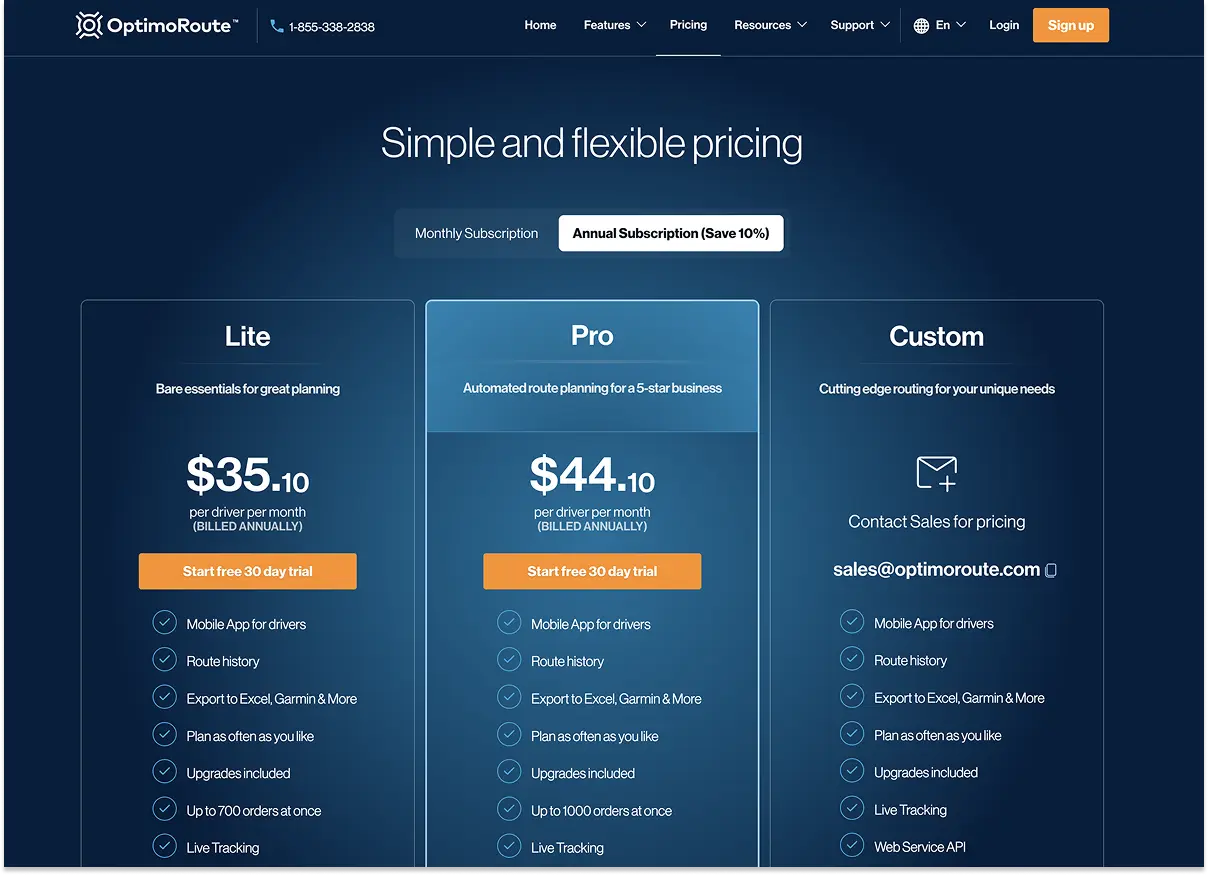
OptimoRoute charges per driver per month:
- Lite: $35.10/driver/month (annual) or $39/month. Capped at 700 orders at once.
- Pro: $44.10/driver/month (annual) or $49/month. Up to 1,000 orders at once, plus analytics, proof of delivery, customer feedback, and weekly planning.
- Custom: Contact sales for larger or more complex operations.
What this means in practice: A business with 10 drivers pays $441/month on the Pro annual plan — before you've added a single extra feature. If you occasionally use contract drivers or your fleet fluctuates seasonally, you'll be constantly adjusting your subscription or paying for capacity you're not using.
The 30-day free trial sounds generous, but note that it's capped at 250 stops — which may not be enough to meaningfully test performance at your actual delivery volumes.
Routific pricing

Routific's per-order pricing scales with your actual delivery volume:
- Up to 100 orders/month: Free
- 101–1,000 orders/month: $150/month flat fee
- Above 1,000 orders: A few cents per order, scaling down as volume increases (from 15c/order at 2,000 to 3c/order above 20,000)
What this means in practice: A business doing 500 orders a month across 5 drivers pays $150 — regardless of how many drivers it uses. If you bring in seasonal or contract drivers, your cost doesn't change. And if you have a quiet month, you pay less.
Bottom line on pricing: For smaller operations (under 1,000 orders/month), Routific is almost always cheaper. For larger operations, the comparison depends heavily on your fleet size. A business doing 5,000 orders a month with 5 drivers will find Routific's per-order cost competitive; one doing 5,000 orders with 20 drivers will need to do the math.
Route optimization quality
Route optimization is where Routific has a consistent advantage — and it's the most important factor for most delivery operations.
Route quality directly affects your bottom line. A poorly optimized route means more fuel, more driver hours, more overtime, and more late deliveries. The difference between a clean route and a spaghetti route isn't just aesthetic.
What Routific does well

Routific has spent over a decade refining its core algorithm. The focus is on driver-friendly routes — ones that minimize criss-crossing, backtracking, and the kind of illogical sequencing that frustrates drivers. The results show up in customer reviews:
The software will automatically optimize the route across my fleet of trucks (10), figuring out how to both balance the load between trucks AND do so in the fewest possible miles. I can instantly see how changes in routing impacts mileage. Incredibly fast, flexible, easy to use. — Peter L, General Manager
Unlike most route planning software, Routific gives dispatchers a live view of the whole day on both a map and a timeline. It also has live route management and editing tools that many others lack:
- Drag and drop route editing: You can move stops within and between routes, on either the timeline or the map view. Move individual stops, or use the lasso tool to define and move whole groups of stops.
- Draw routes: A patented capability unique to Routific: dispatchers can sketch a route directly on the map and the algorithm will follow it. No other major route planner offers this.
- Driver familiarity: The algorithm learns which drivers are most familiar with each area, and suggests the best driver for each route. This is especially helpful once you scale beyond a handful of drivers.
- Copy and move routes: You can move a route to a different day, or copy a recurring route as needed.
You can read more about Routific's route planning and management features here.
Where OptimoRoute falls short on routes
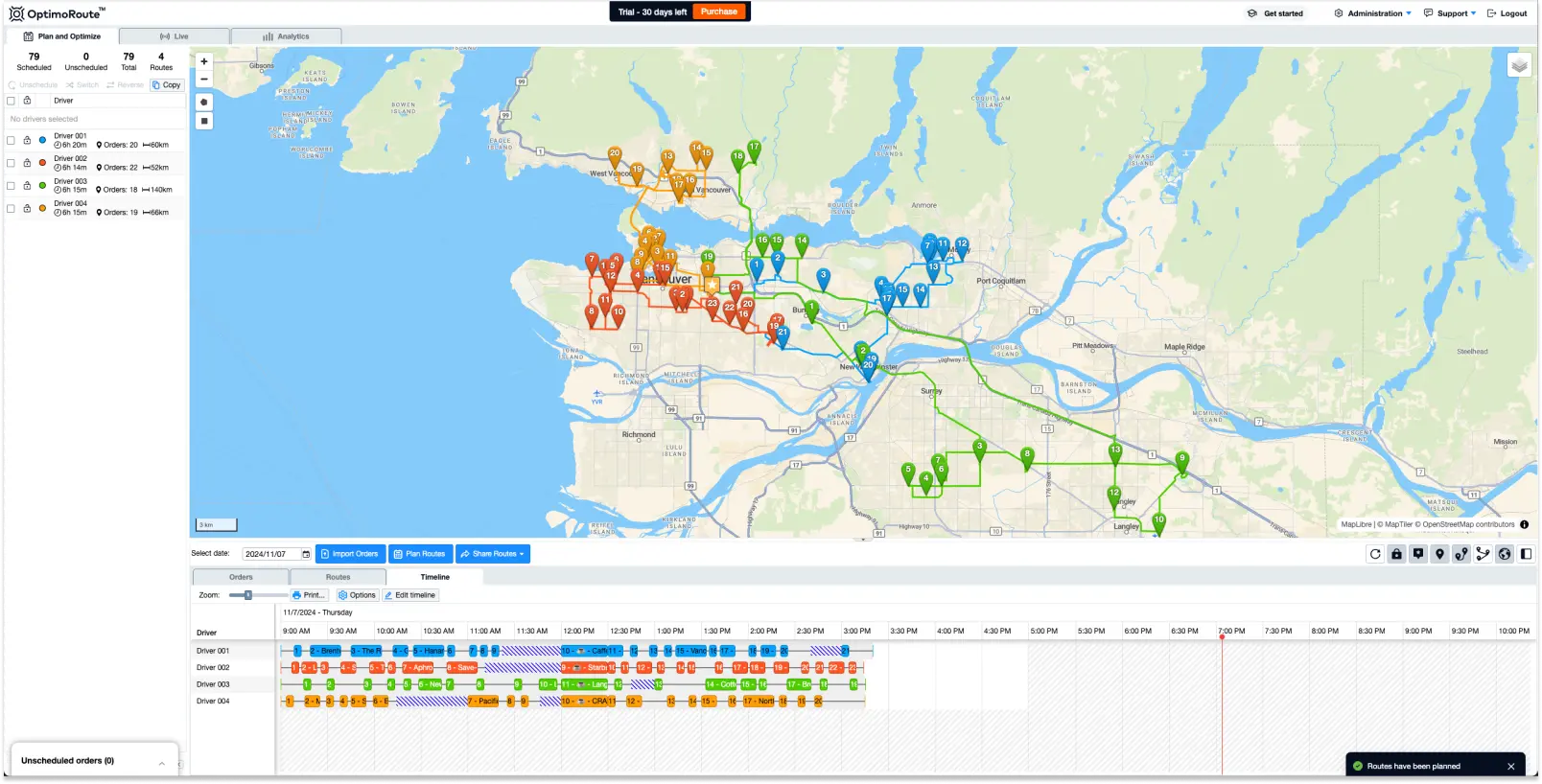
OptimoRoute's route optimization is solid for straightforward operations, but it has known weaknesses. Their optimization tends to produce overlapping routes, and there is no drag-and-drop editing on the timeline.
The maps are outdated, and I almost ALWAYS have to fix the route. It marks roads that are not roads, are blocked off, or it will label a creek or wash as a road. — Eric H, Capterra
Some users also flag a steeper learning curve when setting up and editing routes:
The software can be complex to set up and use initially. The interface may not be as intuitive as some other route planning software, which could result in a steeper learning curve. — Edson Q, G2
Where OptimoRoute wins
There are specific scenarios where OptimoRoute is the stronger choice.
1. Return-to-depot routing
If your drivers need to return to a warehouse or depot mid-route to reload — common for businesses using bikes, small vans, or cargo bikes — OptimoRoute handles this natively. Routific's support for this is limited, although there are workarounds.
2. Weekly planning
OptimoRoute's weekly planning feature (Pro plan and above) lets you plan routes up to five weeks ahead and automatically allocate stops to the most appropriate days. This is useful for field service operations in particular. Routific does allow planning weeks or even months ahead, but can't yet split a batch of orders across multiple days.
3. Detailed driver profiles
OptimoRoute lets you set per-driver parameters including shift schedules, skills, service areas, vehicle types, costs, and speed settings. This is particularly useful for field sales and service organizations, or any business where driver capabilities vary significantly.
4. More comprehensive barcode scanning features
Both OptimoRoute and Routific support barcode scanning for delivery verification — confirming that the right order goes to the right customer. But OptimoRoute goes further: batch scanning for multiple items at once, partial delivery tracking, damaged barcode reporting, and direct integration with inventory, CRM, and ERP systems. If those capabilities matter to your operation, OptimoRoute is the stronger choice.
Note: OptimoRoute only offers barcode scanning on the Pro plan and above. Routific offers it at all price points.
5. Customer feedback collection
OptimoRoute has a built-in feature to let customers rate their delivery experience. Routific doesn't have this.
6. Breadcrumb trails
OptimoRoute tracks vehicle movements and lets dispatchers compare actual vs. planned routes — useful for performance reviews and driver accountability.
Where Routific wins
1. Route quality and driver experience
As covered above, this is Routific's clearest differentiator. Cleaner routes mean fewer manual edits, happier drivers, and lower cost per delivery.
Rapid, same day route creation allowing significant adjustments to be made right up to dispatch. — Chris H, Food & beverage logistics manager, Capterra
2. Ease of use
Routific is consistently described by users as easy to learn with no training required. For small businesses where the route planner might also be the business owner, this matters:
The ease of use, simplicity, and customer service is second to none. I have tried and demoed every routing tool out there and none come close to Routific with ease of use and simplicity. — Morgan H, SMB CEO, Capterra
3. Customer support
Routific maintains a 98% customer satisfaction score — unusually high for a SaaS product. OptimoRoute offers 24/7 support, but customer reviews suggest it's more transactional. Routific's customer support staff are an integral part of the team (not outsourced!) and empowered to solve most problems, with on-call engineers as backup.
4. Scalability
Routific's per-order model and algorithm both scale well. OptimoRoute's 1,000-order-at-once cap on the Pro plan can become a constraint for growing operations — pushing customers toward the Custom tier and its opaque pricing.
5. Flexible start locations
A specific operational advantage: OptimoRoute makes it difficult to adjust route start locations, which can be a problem for businesses using contract drivers who don't all start from the same depot. Routific handles this more flexibly.
Ease of use: dispatcher and driver experience
For dispatchers, Routific's interface is cleaner and more immediately intuitive. The map + timeline combination gives dispatchers a clear picture of the whole day. OptimoRoute offers more configuration options — which is useful if you need them, but adds complexity if you don't.
For drivers, both platforms offer solid mobile apps for iOS and Android. OptimoRoute's app includes barcode scanning; Routific's is cleaner and easier for less tech-savvy drivers:
For dispatchers working with tech-impaired employees, this is a life-saver! The driver app is also attractive with a clean and intuitive UI. It's easy for people to learn to use. — David H, CEO of food and beverage company, Capterra
Who should choose OptimoRoute?
OptimoRoute is the better choice if:
- Your drivers regularly return to a depot to reload during the day.
- You need to plan routes split across multiple days.
- You run a field sales or service operation where detailed driver profiles and skills matter.
- You want customer feedback collection built into the platform.
- Your fleet size is small and relatively stable (the per-driver model is predictable when headcount is fixed).
Who should choose Routific?
Routific is the better choice if:
- You run a food delivery, CSA, meal prep, or similar operation with pre-scheduled deliveries.
- Route quality is a top priority — you want the cleanest, most driver-friendly routes.
- Your fleet fluctuates seasonally or you use contract drivers (per-order pricing wins here).
- You want software that non-technical staff can learn fast with no formal training.
- Customer support matters to you — you want a real human who knows the product.
- You're growing and need a platform that scales without pricing surprises.
How to test both for yourself
The only real way to decide is to sign up for a free trial and run both platforms with your own data. Here's a suggested process:
- Prepare a real stop list — a typical day's worth of deliveries, including time windows and any special requirements.
- Add your drivers with realistic start locations and shift times.
- Run the optimization and look hard at the routes. Are they logical? Would a driver be happy with them? Are the ETAs realistic?
- Edit a route mid-plan and see how each platform handles it.
- Dispatch to a test driver and track the run end-to-end.
- Contact support with a question — the response will tell you a lot.
Routific's trial is free, unlimited, and needs no credit card. OptimoRoute's 30-day trial is longer but capped at 250 stops — you may need to request an increase to test at scale.
💡 Need more delivery management options? See our full comparison of route planning software or our guide to Routific alternatives.
Frequently Asked Questions
Is OptimoRoute cheaper than Routific?

It depends on your operation. OptimoRoute's per-driver pricing can be cheaper for businesses with large delivery volumes and small fleets. For most SMBs doing under 1,000 orders a month, Routific's $150 flat rate is lower. For businesses with fluctuating driver headcount, Routific's per-order model is more predictable.
Does OptimoRoute have a free plan?
No, but it offers a 30-day free trial. Note that the trial is limited to 250 stops, which may not be enough to test performance at your real delivery volumes.
Does Routific have barcode scanning?
Yes — Routific supports barcode scanning to confirm the right order is going to the right customer. OptimoRoute's implementation is more comprehensive, with batch scanning, partial delivery tracking, and direct integration with inventory and CRM systems. If you need that depth, OptimoRoute (or Onfleet) is the better fit.
Is OptimoRoute or Routific better for food delivery businesses?
For pre-scheduled food delivery — meal kits, CSAs, fresh produce boxes — Routific is generally the better fit: cleaner routes, easier to use, and more flexible pricing. For on-demand food delivery (orders dispatched as they come in), neither platform is ideal — you'd want a platform like DoorDash or a dedicated on-demand dispatch system.
Can I switch from OptimoRoute to Routific easily?
Yes. Routific supports CSV import of stop lists in the same format most operations already use, so migration is straightforward. The Routific support team can help with the transition.

Best OptimoRoute Alternatives & Competitors

Route Optimization: Transforming Last-Mile Delivery Operations

How To Improve Delivery Efficiency: A Practical Guide for Growing Businesses



Want to learn more?
Read our Ultimate Guide to Route Optimization
- What is route optimization?
- Algorithms vs humans
- Intelligent route optimization
- Choosing route optimization software
Slash delivery costs by 25% – starting today
No credit cardSet up in minutesCancel anytime