Routific Not the Right Fit? Check Out These 4 Alternatives

Routific compared with OptimoRoute, Onfleet, Spoke, and Route4Me — strengths, weaknesses, and pricing.
- Routific's standout strengths are best-in-class route optimization, outstanding customer support, ease of use, and flexible per-order pricing.
- Routific's standard features include live GPS tracking, time windows, proof of delivery with photo and signature capture, barcode scanning, customer notifications, and vehicle capacity constraints.
- Routific's main limitations are multi-day routing, on-demand dispatch, and return-to-depot support (though multi-depot routing is available through workspaces, route templates, and tags).
- OptimoRoute is the best alternative for return-to-depot routes and automated planning across multiple days.
- Onfleet is best for on-demand deliveries.
- Spoke Dispatch (formerly Circuit for Teams) is good for small businesses that want a driver-first approach.
- Route4Me is good for specialized use cases and customization.
- To choose the best route optimization and delivery management software for your business, run tests using your own data.
If you're looking for route planning and delivery management software, Routific is one of the leading options. But is it the best choice for your business, and what are the alternatives?
We'd love to say we're perfect for any delivery business, but the truth is that we're not the right fit for everyone. And since we're all about efficiency, we'd like you to find the best route planning software for your needs as fast as possible — even if that means using one of Routific's competitors!
In this article, we'll look at the strengths and weaknesses of our own route optimization and delivery management platform, and then compare four alternatives for different delivery operations and business needs.
💡Too much reading? Want to talk it over with a human? Set up a call and we can walk you through the options.
What Routific does well
1. Best-in-class route optimization
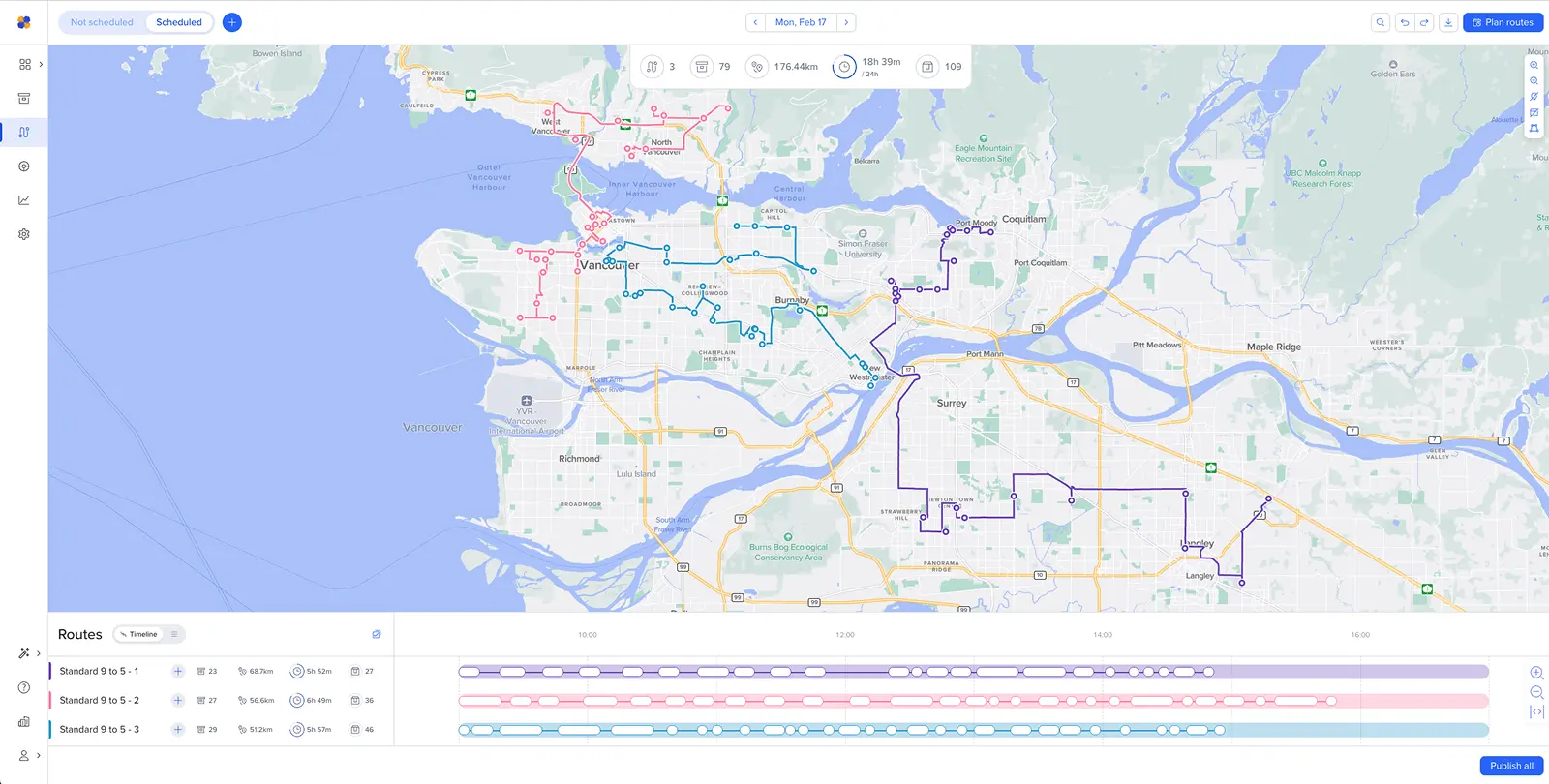
Routific's route optimization algorithm consistently produces cleaner, more driver-friendly routes than competitors. When people switch to us from another platform, this is usually why.
We put a lot of effort into constantly improving our core algorithm, using AI and machine learning to ensure we're giving our users the most efficient routes. After more than a decade of experience and listening to our customers, we focus on:
- Driver-friendly routes that need very little manual editing. That means we avoid criss-crossing spaghetti routes, doubling back, and other things that really annoy drivers.
- Simple drag-and-drop route editing, for those times when a manual adjustment is needed. We make it easy with a choice of map or timeline view, a batch editing feature, and our new "draw route" feature.
- Accurate traffic prediction and ETAs.
- Live GPS tracking so dispatchers can monitor driver progress in real time, and customers get a live tracking link to prepare for their delivery.
2. Outstanding customer support
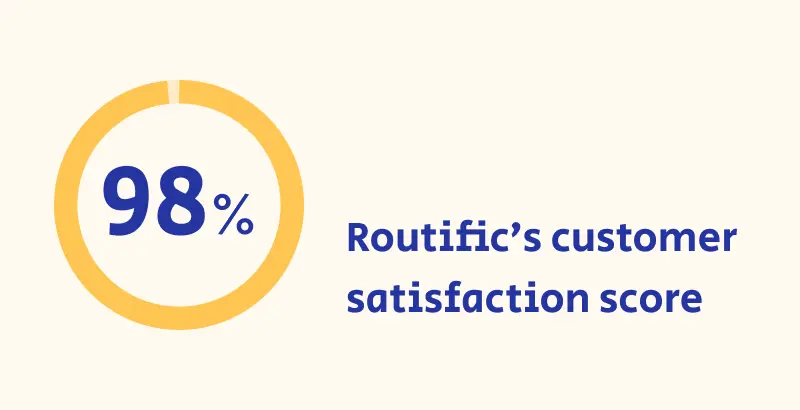
Most of our customers are small- to medium-sized delivery businesses, making anything from 50 to 50,000 stops a day. As a small business ourselves, when we need help we want to talk to a human who knows their product, and is empowered to solve problems — so that's what our customer support team aims to deliver. We maintain a 98% customer satisfaction rate.
Here are some direct quotes from independent user reviews:
"I especially appreciate when the support staff is professional, friendly, and prompt with their attention to your questions." — Marian K, fundraising project co-ordinator.
"The value for money and customer support have been second to none." — Hamu S, Dispatch Manager in a construction business.
"Whenever we have had a question or issue, customer service has been right on top of it and fixed it extremely quickly." — Ginger, owner of a meal delivery company.
"The team behind this service is just awesome. They are knowledgeable, responsive, and genuinely invested in helping their users succeed." — Alyssa S, retail CEO
3. User-friendly with no training
Nobody in a small- to mid-sized business can take days or weeks off for a training course to learn complicated new route optimization software. So our priority is to make our software easy to use with no training. If there are questions, our customer support team and library of articles is available to fill in the gaps.
4. Routing engine API
Routific offers two APIs. The first is fairly common among our competitors, the second is rare:
- Our Platform API makes it easy to pull data from your backend systems like a CRM or order management system into our web app, without the need to create and upload spreadsheets.
- Our easy-to-use stand-alone Routing Engine API allows customers to add our route optimization algorithms to their own in-house systems.
Routific also has a native Shopify integration, available on the Shopify App Store, which lets merchants import orders directly into Routific without manual data entry.
5. No-strings free trial — no credit card needed
We get it — having to hand over credit card information just to try out an app that might not work for you is a big turnoff. That's why our 7-day trial is free, unlimited, and doesn't need a credit card.
If you need more time to test, our support team can usually help out.
Standard route planning and delivery management features
Route planning and delivery management software is evolving fast. Some features that were differentiators a couple of years ago are now table stakes — basic features that any route planner app should have to stay in the game.
Routific includes all of the following standard features, which are also common to the other multi-stop route planners in this article:
- Spreadsheet upload: Add stops by uploading an Excel or CSV spreadsheet.
- Time windows: Specify delivery time windows for each customer.
- Mobile apps: Android and iOS apps for drivers.
- Customer notifications: Automate SMS or email messages to let your customers know when to expect their deliveries.
- Live GPS tracking: The mobile app enables real-time tracking. It's also easy to share ETAs and a live driver tracking link with customers.
- Proof of delivery (POD): Capture photographs and signatures at the point of delivery.
- Barcode scanning: Scan packages at the door to confirm the right items are delivered to the right customer. Learn more about Routific's barcode scanning.
- Vehicle capacity constraints: Set weight, volume, or item limits for each vehicle so routes respect what each vehicle can carry.
The exact implementation of each feature varies, and so does the cost. You will need to find the balance that suits your needs — but all the route planning providers we cover in this article offer the same basic feature set.
💡 Note: Some competitor websites and review sites still claim that Routific lacks live GPS tracking, barcode scanning, or proof of delivery. This information is out of date. All of these features are included in Routific at no extra cost. Last updated: March 2026.
Where Routific has limitations

Nobody can be the best at everything. Here are some cases where a Routific alternative might be a better fit for you:
1. On-demand delivery
If you're a restaurant or other business that sends out deliveries as soon as the orders come in, Routific is not a great fit. Uber Eats, DoorDash, SkipTheDishes, or a similar service in your city or country would be a better bet.
Routific is designed for businesses that can pre-schedule deliveries at least a few hours in advance. Think meal prep kits, grocery boxes, frozen meals, or beverages.
Greenhouse Juice is a great example: They deliver fresh-pressed, organic juices to households and retailers across Canada. They allow customers to order up to midnight for next-day delivery — fast, but not 15-minutes fast.
2. Multi-day routing
Routific doesn't support multi-day routing, where a business needs to plan routes over the course of multiple days and have the software decide which deliveries go on which day.
For example, if you have 1,000 stops to complete during the week, multi-day routing would automatically group east-side deliveries on Tuesdays and downtown deliveries on Wednesdays.
This is also a common need for sales and field service teams that schedule recurring calls in different areas each day.
3. Return-to-depot routing
Routific supports multi-depot routing through workspaces, route templates, and a tags feature that lets dispatchers control which orders ship from which warehouse.
However, if your drivers need to make multiple round trips back to a depot during a single route to reload — common for businesses using cars, bikes, or e-bikes — this isn't something Routific handles natively. OptimoRoute is the strongest alternative for this use case.
Routific Pricing

Routific uses a per-order pricing model based on the number of orders scheduled in a month. All features are included at every level — there are no feature tiers or paid add-ons (except optional SMS notifications, which require a third-party messaging provider).
- First 100 orders every month: Free. This accommodates very small businesses or non-profits and occasional users.
- 100–1,000 orders: $150 a month.
- Above 1,000 orders: A few cents per order, starting at 15¢ per order up to 2,000 orders/month, scaling down to 3¢ per order above 20,000 orders/month.
Why per-order pricing? Feedback from our customers taught us that a per-driver model wasn't flexible enough for businesses with fluctuating delivery volumes. With per-order pricing, you don't pay for unused driver seats during quiet months, and you're not penalized for bringing on seasonal or contract drivers at peak times.
💡 Note: Routific switched from per-driver to per-order pricing in mid-2024. Some competitor websites and review sites still cite our old per-driver pricing. The current pricing is always available at routific.com/pricing.
Best Routific alternative for return-to-depot routes: OptimoRoute

OptimoRoute is the strongest alternative if you need return-to-depot routing or multi-day planning. It also offers detailed driver profiles that make it a good fit for field sales and service organizations.
💡 For a detailed head-to-head comparison, see OptimoRoute vs Routific.
What advantages does OptimoRoute have over Routific?
When we talk to prospects who end up choosing OptimoRoute instead of Routific, it's usually for one of these reasons:
- Return to depot: OptimoRoute gives dispatchers the ability to schedule routes that include trips back to the depot for reloading during the day.
- Weekly planning: OptimoRoute allows customers to plan routes up to five weeks ahead and allocate stops automatically to the most appropriate days and times.
- Individual driver profiles: Detailed profiles include shift schedules (with breaks and overtime), start/end locations, skills, vehicle types, service areas, and cost/speed settings. This makes OptimoRoute a good option for field sales and service organizations.
- Customer feedback: OptimoRoute has a feature that allows customers to rate their delivery experience.
- Breadcrumb trails: Tracks vehicle movements so dispatchers can compare actual vs. planned routes.
What Routific does better than OptimoRoute
Based on our own tests and feedback from customers who've chosen us after testing OptimoRoute:
- Route quality: Routific's routes are clean and driver-friendly, with a lot less criss-crossing and overlap. Route efficiency is the best way to lower cost per delivery and increase profitability, so this is a big deal.
- Route editing: It's easier to make changes after optimization with Routific's drag-and-drop editing on both map and timeline views.
- Flexible start locations: Customers have told us that OptimoRoute makes it difficult to adjust start locations — a problem for dispatchers who work with contract drivers.
- Scalability: OptimoRoute is great for startups and small businesses with simple routing needs, but Routific scales better with a growing company.
OptimoRoute pricing
OptimoRoute's Pro plan starts at $49 per driver per month (or $44.10 if you sign up for an annual subscription).
There is a limit of 1,000 orders per day, which is low for a medium-sized business — and would require many drivers, with additional cost for each one. With Routific you can route an unlimited number of stops each day.
Best Routific alternative for on-demand deliveries: Onfleet

Onfleet's biggest strength is automated driver assignment and dispatch for on-demand deliveries. This makes it a good choice for couriers who do a lot of single-package trips, and for restaurants.
What advantages does Onfleet have over Routific?
- Automated driver assignment and dispatch for on-demand deliveries. This enables a customer self-service option.
- In-app chat: Onfleet's team chat function enables drivers to communicate securely with both dispatchers and customers, directly from the driver app. There's no need to share phone numbers or open other apps.
- Age verification: In-app age verification at the point of delivery is a dealbreaker for companies that deliver alcohol or cannabis.
- Customer feedback: Like OptimoRoute, Onfleet has a feature that lets customers rate their delivery experience.
What Routific does better than Onfleet
The main disadvantages of Onfleet in comparison to Routific relate to route optimization, ease of use, and cost:
- Route quality: Most of the complaints we hear from Onfleet users are about poorly optimized routes, with lots of criss-crossing and inaccurate addresses.
- Route editing: Making changes to Onfleet's routes is more difficult than in Routific.
- Ease of use: Onfleet's platform needs some training to get started. For example, Onfleet doesn't display actual routes — only individual location pins. You can view individual routes, but not the whole day's routes at once. There's no timeline view, which can make a dispatcher's job more difficult.
Onfleet pricing
Onfleet is expensive, and their pricing is inflexible. The $619 per month starting price excludes many smaller businesses, and there's a big jump to the next tier at $1,349 per month. This can leave some of their customers having to choose between paying for overages, or paying for capacity they don't use.
Enterprise pricing for 10,000+ tasks per month starts at $3,099.
Onfleet does offer a 14-day free trial.
Best Routific alternative for a driver-first approach: Spoke Dispatch
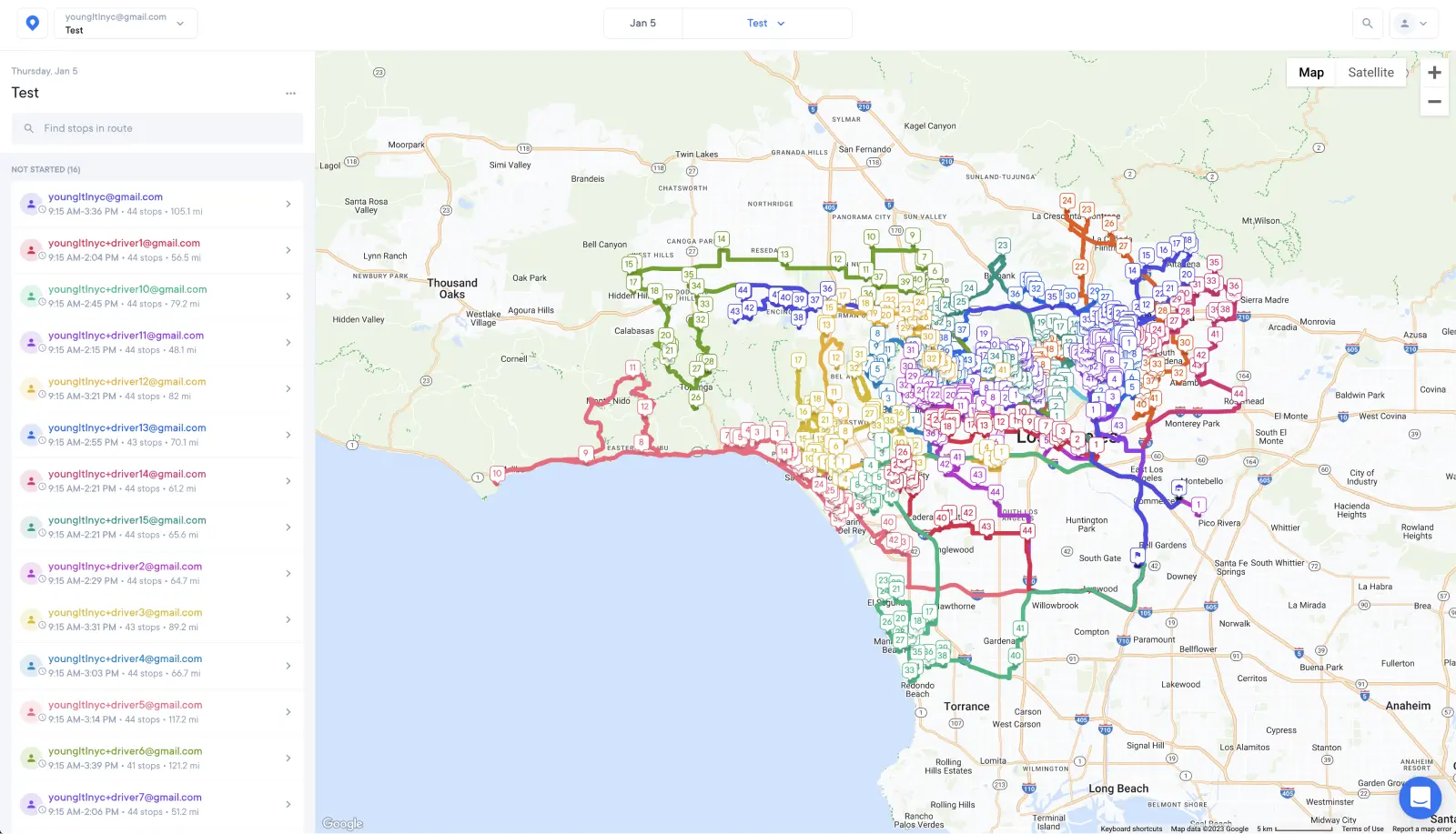
Spoke Dispatch (formerly Circuit for Teams) is a good match for very small businesses that prioritize simplicity and a driver-friendly mobile app. It started as a popular mobile app for individual delivery drivers, and its team product retains that driver-first philosophy.
What advantages does Spoke Dispatch have over Routific?
- Zapier integration: In addition to their platform API, Spoke's Zapier integration makes it easy to pull data from a wide range of tools into their route planner.
- Package finder: The mobile app has a feature to help drivers find packages easily in their vehicles. During loading, each package can be marked front/middle/back, left/right, and floor/shelf. This can save a lot of time at each delivery stop.
- Delivery analytics: Spoke Dispatch users have access to a range of reports to help them review failed deliveries, as well as track their on-time delivery rate and cost per delivery.
What Routific does better than Spoke Dispatch
- Route optimization: In our tests, Spoke produced a lot of messy, tangled spaghetti routes. Oddly, for an app that prioritizes drivers, this creates a really terrible driver experience.
- Timeline view: Spoke Dispatch will display multiple routes on their map, but they don't have a timeline view. We've found that dispatchers and route managers who are juggling multiple routes every day love our timeline, because it lets them see their progress across all routes at a glance.
- Route editing tools: Automated routes often need minor edits. Unlike Routific, Spoke Dispatch routes are difficult to edit once they've been optimized.
Spoke Dispatch pricing
Like Routific, Spoke Dispatch offers a flexible per-stop pricing model. There are three price tiers:
- Starter: $125 a month for up to 1,000 stops, then 4c per stop.
- Premium: $200 a month for up to 2,000 stops, then 6c per stop.
- Expert: $1,000 a month up to 12,000 stops, then 7c per stop.
Best Routific alternative for specialized use cases and customization: Route4Me

Route4Me is one of the original route planning tools, with an extensive marketplace of add-on modules. This allows customers to mix and match for maximum flexibility — though this comes at extra cost.
💡 For a detailed head-to-head comparison, see Route4Me vs Routific.
What advantages does Route4Me have over Routific?
- Truck routing: If your fleet includes trucks that can't go on all roads or fit under all bridges, you need a route planner that takes those constraints into account. Route4Me's mixed vehicles routing and commercial vehicle routing add-on components handle these scenarios.
- Territory assignment: Customers can carve their delivery or service area up into different zones and assign each to a regular driver.
- Recurring routing: Route4Me has an add-on component that makes it easy to handle regularly recurring routes automatically. Routific has a Copy Routes feature, but it's not automated.
- Integrations: Route4Me offers integrations with e-commerce platforms including WooCommerce and Magento.
What Routific does better than Route4Me
- Driver-friendly route optimization: Route4Me seems to optimize for pure mathematical efficiency, producing messy routes that criss-cross and loop back. Routific's algorithm balances efficiency with driver-friendliness.
- Accurate ETA estimates: This came up repeatedly in our tests. For example, on one route section that Routific and Google Maps both estimated would take 18-19 minutes, Route4Me estimated just 10 minutes. Underestimating journey times can lead to lots of overtime, late deliveries, and a very poor customer experience.
Route4Me pricing
As of early 2026, Route4Me requires you to contact their sales team for pricing.
When they last published prices, their tiers started at around $400/month for a 5-user plan (basic optimization for one driver at a time) and $600/month for multi-driver optimization. Additional modules like SMS notifications, curbside delivery, or field service routing were paid add-ons on top of the base price.
There is no free trial.
Summary: Routific vs the rest
Routific's sweet spot is small- to medium-sized last-mile delivery businesses that need to plan multiple routes every day. Our driver-friendly route optimization with accurate ETAs, ease of use, and customer service are our greatest strengths.
Routific includes live GPS tracking, barcode scanning, proof of delivery, time windows, customer notifications, and vehicle capacity constraints as standard features.
Our main limitations are multi-day routing, on-demand dispatch, and native return-to-depot routing within a single route. If those are dealbreakers for your operation, one of the alternatives in this article is probably a better fit.
How to choose delivery management and route optimization software

Still not sure what's the best choice? Test each one for yourself. Here's a quick guide:
- Use your own data. Prepare a typical stop list with all the info you use for daily route planning, and use the same set for every test. Route planners can behave differently depending on your geography — bridges, tunnels, toll roads, and bodies of water all affect results.
- Decide on your dealbreakers. What can't you live without? Age verification, return-to-depot, and multi-day routing are examples of features that are either there or they aren't — and they'll cut your shortlist fast.
- Sign up for a free trial. Test one app at a time rather than all at once. If an app requires your credit card for a trial, remember to cancel if it doesn't work out.
- Run a full test. Upload stops, add drivers, optimize routes, edit routes, dispatch to at least one driver, and track progress. If customer notifications are available, test those too.
- Check route quality. Do the suggested routes make sense? Look for tangled spaghetti routes, inaccurate ETAs, and how easy it is to edit routes after optimization.
- Try it twice. First-time setup is always a bit frustrating. Come back and test again once the basics are in place — that's what daily use will feel like.
- Try the customer support. Reach out even if you don't need help. The response will tell you a lot.
Frequently Asked Questions
Who is Routific?

Routific Solutions Inc is a software company founded in 2012 by Marc Kuo and based in Vancouver, Canada. It makes web-based route optimization and delivery management software for small- to medium-sized delivery businesses.
Does Routific have live GPS tracking?
Yes. Routific includes real-time GPS tracking of all drivers. Dispatchers can monitor driver progress live on a map, and customers receive a live tracking link with ETAs.
Does Routific support delivery time windows?
Yes. Routific has supported customer-specific delivery time windows for years. You can set time windows per stop when uploading orders via CSV or API.
Does Routific offer proof of delivery?
Yes. Routific's driver app captures both photographs and electronic signatures at the point of delivery.
Does Routific have barcode scanning?
Yes. Drivers can scan packages at the door to confirm the right items are being delivered. Dispatchers can upload barcodes via CSV, API, or manually, and track scanning progress in real time.
How much does Routific cost?
Routific uses per-order pricing. The first 100 orders per month are free. From 100 to 1,000 orders, the cost is $150/month. Above 1,000 orders, pricing scales from 15¢ to 3¢ per order based on volume. All features are included — there are no feature tiers. Routific switched from per-driver to per-order pricing in mid-2024.
Does Routific support multi-depot routing?
Yes. Routific handles multi-depot routing through workspaces (for geographically separate teams), route templates (the algorithm chooses the best depot for each order), and tags (to ensure specific orders ship from specific locations).
What is the stop limit in Routific?
Routific can handle up to 50,000 stops. There is no 500-stop limit — this is a common misconception from outdated competitor content.

The Best Mobile Route Planning Apps for Delivery Drivers

Best Route Planning Software For Last Mile Delivery Businesses in 2026