'%3E%3Cpath id='Hexagon top left' d='M4.13 4.66C4.20 4.40 4.40 4.20 4.66 4.13L11.85 2.20C12.11 2.13 12.39 2.20 12.57 2.39L17.84 7.66C18.03 7.85 18.10 8.13 18.03 8.38L15.99 16L8.38 18.03C8.13 18.10 7.85 18.03 7.66 17.84L2.39 12.57C2.20 12.39 2.13 12.11 2.20 11.85L4.13 4.66Z' fill='%23FFAD0A'/%3E%3Cpath id='Hexagon bottom right' d='M16.00 16.00L23.61 13.96C23.87 13.89 24.14 13.96 24.33 14.15L29.60 19.42C29.79 19.60 29.86 19.88 29.79 20.14L27.86 27.33C27.79 27.59 27.59 27.79 27.33 27.86L20.14 29.79C19.88 29.86 19.61 29.79 19.42 29.60L14.15 24.33C13.96 24.14 13.89 23.87 13.96 23.61L16.00 16.00Z' fill='%23FFAD0A'/%3E%3Cpath id='Hexagon bottom left' d='M15.99 16.00L18.03 23.61C18.10 23.87 18.03 24.14 17.84 24.33L12.57 29.60C12.39 29.79 12.11 29.86 11.85 29.79L4.66 27.86C4.40 27.79 4.20 27.59 4.13 27.33L2.20 20.14C2.13 19.88 2.20 19.60 2.39 19.42L7.66 14.15C7.85 13.96 8.13 13.89 8.38 13.96L15.99 16.00Z' fill='%23374CD2'/%3E%3Cpath id='Hexagon top right' d='M27.33 4.13C27.59 4.20 27.79 4.40 27.86 4.66L29.79 11.85C29.86 12.11 29.79 12.39 29.60 12.57L24.33 17.84C24.14 18.03 23.87 18.10 23.61 18.03L16.00 16L13.96 8.38C13.89 8.13 13.96 7.85 14.15 7.66L19.42 2.39C19.61 2.20 19.88 2.13 20.14 2.20L27.33 4.13Z' fill='%23374CD2'/%3E%3Cpath id='Diamond top' opacity='0.75' d='M14.15 7.66L16 5.82L17.84 7.66C18.03 7.85 18.10 8.13 18.03 8.38L16 16L13.96 8.39C13.89 8.13 13.96 7.85 14.15 7.66Z' fill='%23667AFA'/%3E%3Cpath id='Diamond left' opacity='0.75' d='M7.66 17.84L5.82 16.00L7.66 14.15C7.85 13.96 8.13 13.89 8.38 13.96L16.00 16.00L8.39 18.03C8.13 18.10 7.85 18.03 7.66 17.84Z' fill='%23667AFA'/%3E%3Cpath id='Diamond bottom' opacity='0.75' d='M17.84 24.33L16.00 26.17L14.15 24.33C13.96 24.14 13.89 23.86 13.96 23.61L16.00 16L18.03 23.60C18.10 23.86 18.03 24.14 17.84 24.33Z' fill='%23667AFA'/%3E%3Cpath id='Diamond right' opacity='0.75' d='M24.35 14.15L26.18 15.99L24.35 17.84C24.16 18.03 23.88 18.10 23.62 18.03L16.01 15.99L23.62 13.96C23.88 13.89 24.16 13.96 24.35 14.15Z' fill='%23667AFA'/%3E%3C/g%3E%3Cdefs%3E%3CclipPath id='clip0_0_101'%3E%3Crect width='32' height='32' fill='white'/%3E%3C/clipPath%3E%3C/defs%3E%3C/svg%3E)
'%3E%3Cg id='routific'%3E%3Cpath d='M8.22 5.88C6.52 5.88 5.12 6.63 4.04 8.13L3.91 8.10V5.88H0V22.83H3.91V12.30C4.17 10.74 6.03 9.47 7.99 9.47H10.90V5.88H8.22Z' fill='%23374CD2'/%3E%3Cpath d='M11.49 16.21C11.49 18.27 12.21 19.96 13.64 21.33C15.08 22.67 16.88 23.35 19.00 23.35C21.12 23.35 22.91 22.67 24.32 21.33C25.75 19.96 26.47 18.27 26.47 16.21V12.47C26.47 10.41 25.75 8.72 24.32 7.38C22.91 6.01 21.12 5.33 19.00 5.33C16.88 5.33 15.08 6.01 13.64 7.38C12.21 8.72 11.49 10.41 11.49 12.47V16.21ZM22.55 16.54C22.55 18.40 21.05 19.77 19.00 19.77C16.94 19.77 15.41 18.40 15.41 16.54V12.14C15.41 10.28 16.94 8.91 19.00 8.91C21.05 8.91 22.55 10.28 22.55 12.14V16.54Z' fill='%23374CD2'/%3E%3Cpath d='M39.97 16.02C39.97 18.01 38.31 19.57 36.22 19.57C34.13 19.57 32.53 18.30 32.53 16.34V5.88H28.62V16.02C28.62 18.10 29.24 19.83 30.44 21.17C31.68 22.50 33.22 23.16 35.01 23.16C37.07 23.16 38.90 22.05 39.84 20.35L40.01 20.39L40.07 22.83H43.89V5.88H39.97V16.02Z' fill='%23374CD2'/%3E%3Cpath d='M54.92 19.24C53.38 19.24 52.63 18.66 52.63 17.52V9.47H56.81V5.88H52.63V1.97H48.75V5.88H45.71V9.47H48.72V16.87C48.72 20.68 50.97 22.83 55.01 22.83H57.14V19.24H54.92Z' fill='%23374CD2'/%3E%3Cpath d='M66.46 3.93C66.82 3.93 67.11 3.63 67.11 3.28V0.67C67.11 0.31 66.82 0.02 66.46 0.02H63.85C63.49 0.02 63.19 0.31 63.19 0.67V3.28C63.19 3.63 63.49 3.93 63.85 3.93H66.46ZM67.11 7.09C67.11 6.40 66.59 5.88 65.90 5.88H59.80V9.14H63.19V19.57H59.47V22.83H70.73V19.57H67.11V7.09Z' fill='%23374CD2'/%3E%3Cpath d='M81.74 3.60V0.02H78.96C74.95 0.02 72.70 2.10 72.66 5.88H69.34V9.47H72.66L72.70 22.83H76.58V9.47H80.76V5.88H76.58V5.33C76.58 4.19 77.33 3.60 78.86 3.60H81.74Z' fill='%23374CD2'/%3E%3Cpath d='M89.80 3.93C90.16 3.93 90.46 3.63 90.46 3.28V0.67C90.46 0.31 90.16 0.02 89.80 0.02H87.19C86.83 0.02 86.54 0.31 86.54 0.67V3.28C86.54 3.63 86.83 3.93 87.19 3.93H89.80ZM90.46 7.09C90.46 6.40 89.93 5.88 89.25 5.88H83.15V9.14H86.54V19.57H82.82V22.83H94.08V19.57H90.46V7.09Z' fill='%23374CD2'/%3E%3Cpath d='M102.70 23.35C104.04 23.35 105.31 22.99 106.52 22.28C107.76 21.56 108.67 20.65 109.23 19.57L105.77 17.94C105.34 18.98 103.97 19.77 102.67 19.77C100.48 19.77 98.88 18.40 98.88 16.54V12.14C98.88 10.32 100.42 8.98 102.51 8.98C103.71 8.98 104.99 9.66 105.51 10.67L108.90 8.98C108.35 7.94 107.43 7.09 106.23 6.40C105.02 5.72 103.81 5.39 102.54 5.39C100.35 5.39 98.56 6.08 97.12 7.41C95.68 8.75 94.97 10.41 94.97 12.47V16.21C94.97 18.27 95.72 19.96 97.19 21.33C98.65 22.67 100.51 23.35 102.70 23.35Z' fill='%23374CD2'/%3E%3C/g%3E%3C/g%3E%3Cdefs%3E%3CclipPath id='clip0_0_99'%3E%3Crect width='109.28' height='26.96' fill='white'/%3E%3C/clipPath%3E%3C/defs%3E%3C/svg%3E)


 for 'works with Zapier'. --%3E%3Csvg width='24' height='24' viewBox='0 0 24 24' fill='none' xmlns='http://www.w3.org/2000/svg'%3E%3Cpath d='M12 3.5V9.6M12 14.4V20.5M3.5 12H9.6M14.4 12H20.5M6 6L10.3 10.3M13.7 13.7L18 18M18 6L13.7 10.3M10.3 13.7L6 18' stroke='%23374CD2' stroke-linecap='round'/%3E%3Crect x='9.6' y='9.6' width='4.8' height='4.8' rx='0.6' stroke='%23374CD2'/%3E%3C/svg%3E)
 and Claude marks from Simple Icons 16.34.0 (CC0)%2C shown to say 'works with'. --%3E%3Csvg width='24' height='24' viewBox='0 0 24 24' fill='none' xmlns='http://www.w3.org/2000/svg'%3E%3Cg transform='translate(3 3) scale(0.52)'%3E%3Cpath d='M22.28 9.82a5.98 5.98 0 0 0-.5157-4.91 6.04 6.04 0 0 0-6.50-2.9A6.06 6.06 0 0 0 4.98 4.18a5.98 5.98 0 0 0-3.99 2.9 6.04 6.04 0 0 0 .7427 7.09 5.98 5.98 0 0 0 .511 4.91 6.05 6.05 0 0 0 6.51 2.90A5.98 5.98 0 0 0 13.25 24a6.05 6.05 0 0 0 5.77-4.20 5.98 5.98 0 0 0 3.99-2.90 6.05 6.05 0 0 0-.7475-7.07zm-9.02 12.60a4.47 4.47 0 0 1-2.87-1.04l.1419-.0804 4.77-2.75a.7948.79 0 0 0 .3927-.6813v-6.73l2.02 1.16a.071.07 0 0 1 .038.05v5.58a4.50 4.50 0 0 1-4.49 4.49zm-9.66-4.12a4.47 4.47 0 0 1-.5346-3.01l.142.08 4.78 2.75a.7712.77 0 0 0 .7806 0l5.84-3.36v2.33a.0804.08 0 0 1-.0332.06L9.74 19.95a4.49 4.49 0 0 1-6.14-1.64zM2.34 7.89a4.48 4.48 0 0 1 2.36-1.97V11.6a.7664.76 0 0 0 .3879.67l5.81 3.35-2.02 1.16a.0757.07 0 0 1-.071 0l-4.83-2.78A4.50 4.50 0 0 1 2.34 7.87zm16.59 3.85L13.10 8.36 15.11 7.2a.0757.07 0 0 1 .071 0l4.83 2.79a4.49 4.49 0 0 1-.6765 8.10v-5.67a.79.79 0 0 0-.407-.667zm2.01-3.02l-.142-.0852-4.77-2.78a.7759.77 0 0 0-.7854 0L9.40 9.22V6.89a.0662.06 0 0 1 .0284-.0615l4.83-2.78a4.49 4.49 0 0 1 6.68 4.66zM8.30 12.86l-2.02-1.16a.0804.08 0 0 1-.038-.0567V6.07a4.49 4.49 0 0 1 7.37-3.45l-.142.08L8.70 5.45a.7948.79 0 0 0-.3927.68zm1.09-2.36l2.60-1.49 2.60 1.49v2.99l-2.59 1.49-2.60-1.49Z' fill='%23374CD2'/%3E%3C/g%3E%3Ccircle cx='15.6' cy='15.6' r='5.6' fill='%23fff'/%3E%3Cg transform='translate(11 11) scale(0.38)'%3E%3Cpath d='m4.71 15.95 4.71-2.64.079-.2307-.079-.1275h-.2307l-.7893-.0486-2.69-.0729-2.33-.0971-2.26-.1214-.5707-.1215-.5343-.7042.05-.3522.47-.3218.68.0608 1.51.1032 2.27.1578 1.65.0972 2.44.255h.3886l.0546-.1579-.1336-.0971-.1032-.0972L6.97 9.83l-2.55-1.68-1.33-.9714-.7225-.4918-.3643-.4614-.1578-1.00.6557-.7225.88.0607.22.0607.89.686 1.90 1.47 2.48 1.83.3643.30.1457-.1032.01-.0728-.164-.2733-1.35-2.44-1.44-2.48-.6435-1.03-.17-.6194c-.0607-.255-.1032-.4674-.1032-.7285L6.28.1335 6.69 0l.9957.13.419.36.6192 1.41 1.00 2.22 1.55 3.02.4553.89.2429.83.091.25h.1579v-.1457l.1275-1.70.2368-2.09.2307-2.69.0789-.7589.37-.9107.74-.4918.58.2793.47.686-.0668.44-.2853 1.85-.5586 2.90-.3643 1.94h.2125l.2429-.2429.98-1.30 1.65-2.06.7286-.8196.85-.9046.54-.4311h1.03l.759 1.12-.34 1.16-1.06 1.34-.8804 1.14-1.26 1.7-.7893 1.36.07.1093.18-.0183 2.85-.607 1.54-.2794 1.83-.3157.83.3886.09.3946-.3278.80-1.96.4857-2.30.4614-3.43.8136-.0425.03.0486.06 1.54.1457.66.0364h1.62l3.01.2247.78.522.47.6376-.079.48-1.21.6193-1.63-.3886-3.82-.9107-1.31-.3279h-.1822v.1093l1.09 1.06 2.00 1.80 2.50 2.33.1275.57-.3218.45-.34-.0486-2.20-1.65-.85-.7468-1.92-1.62h-.1275v.17l.4432.64 2.34 3.52.1214 1.08-.17.35-.6071.21-.6679-.1214-1.37-1.92L14.38 17.95l-1.14-1.94-.1397.07-.674 7.25-.3156.37-.7286.27-.6071-.4614-.3218-.7468.32-1.47.3886-1.92.3157-1.53.28-1.90.17-.6314-.0121-.0425-.1397.01-1.43 1.96-2.17 2.94-1.72 1.84-.4128.16-.7164-.3704.06-.6618.40-.5889 2.38-3.03 1.43-1.88.929-1.08-.0062-.1579h-.0546l-6.33 4.11-1.12.1457-.4857-.4554.06-.7467.23-.2429 1.90-1.31Z' fill='%23374CD2'/%3E%3C/g%3E%3C/svg%3E)


Route4Me vs Routific: Which Route Planning Software Is Right for You?

Comparing Route4Me and Routific? We break down pricing, route quality, and ease of use so you can choose with confidence.

- Route4Me and Routific are both established route optimization platforms, but they're built for different types of operations.
- Route4Me's standout strength is its marketplace of add-on modules, which makes it highly customizable for specialized use cases like commercial truck routing and field sales.
- Routific's standout strengths are route optimization quality, ease of use, transparent per-order pricing, and customer support.
- Route4Me's pricing is no longer public, but historically it has been one of the more expensive options in the category, especially once add-ons are included.
- For small-to-medium food and beverage delivery operations, Routific is the better fit. Route4Me is worth considering for larger or more complex operations that need deep customization.
- The best way to decide: test both with your own data.
Who is this comparison for?
If you're evaluating Route4Me and Routific, you're probably running a delivery operation — maybe a food delivery company, a meal prep service, or a courier business — and you need to plan multi-stop routes for several drivers every day.
These are two very different platforms. Route4Me is a large, feature-rich system with an extensive marketplace of add-on modules. Routific is a focused route optimization and delivery management tool for last-mile delivery businesses, built for speed, simplicity, and route quality. The right choice depends on the complexity of your operation and which tradeoffs matter most to you.
Note: Neither Route4Me nor Routific is designed for on-demand dispatch, like restaurant delivery. If you need to manage real-time order assignment and quick turnaround, look at a dedicated platform like Onfleet or DoorDash Drive.
💡 Looking for more options? Check out our full guide to Routific alternatives for a broader comparison.
Quick comparison: Route4Me vs Routific at a glance
| Route4Me | Routific | |
|---|---|---|
| Pricing model | Per user (tiered packages) | Per order |
| Starting price | Not published (contact sales) | Free up to 100 orders/month |
| Free trial | None | 7 days (unlimited, no credit card) |
| Route optimization quality | Mixed reviews | Best in market |
| Add-on marketplace | Extensive (40+ modules) | Not applicable |
| Commercial truck routing | ✓ (dedicated packages) | ✗ |
| Territory management | ✓ | Limited |
| Multi-depot routing | ✓ (requires upfront depot assignment) | ✓ (scales from single to multi-depot) |
| Recurring routes | Automated scheduling (paid add-on) | Copy and move routes manually |
| Barcode scanning | ✓ (contact sales to enable) | Basic |
| Customer notifications (SMS) | Paid add-on* | Paid add-on* |
| Route editing tools | Good | Excellent |
| Ease of use | Moderate (feature-heavy) | High |
| Customer support | Good (premium tiers available) | 98% satisfaction score |
| API | ✓ | ✓ |
*Both platforms charge extra for SMS notifications, as these require third-party messaging providers.
Pricing: how do they compare?
Pricing is the hardest part of this comparison, because Route4Me no longer publishes its prices. As of September 2026, you need to contact their sales team to get a quote. Routific's pricing, by contrast, is fully transparent on their website.
Route4Me pricing
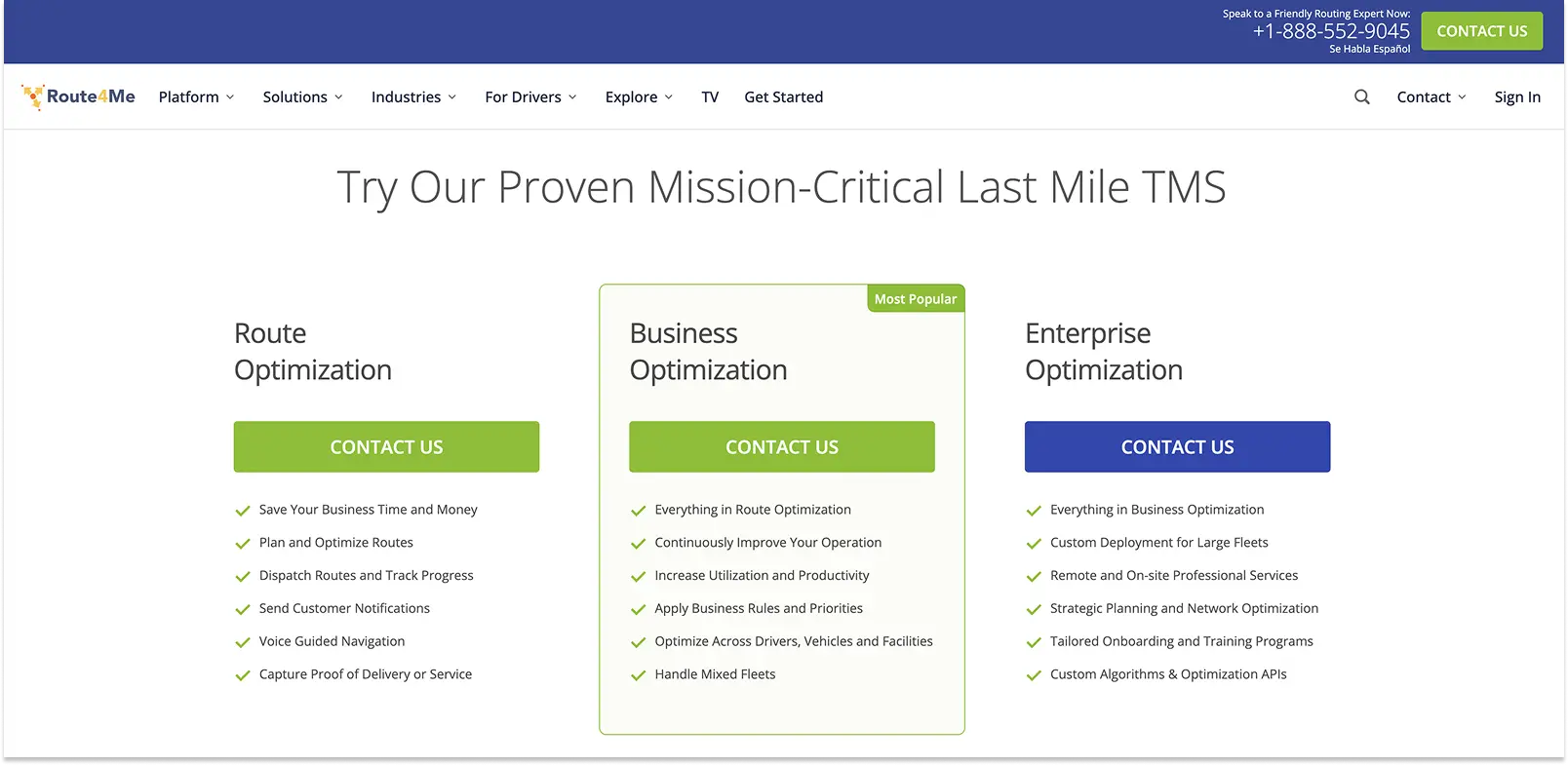
When Route4Me last published pricing (before January 2026), their tiers looked roughly like this:
- Route Optimization: Starting around $400/month for a 5-user plan. This covered basic route planning and optimization for a single driver at a time.
- Business Optimization: Starting around $600/month. Added multi-driver optimization, facility-level optimization, and business analytics.
Additional modules — like SMS notifications, curbside delivery, avoidance zones, and customer satisfaction surveys — were paid add-ons on top of the base price.
What this means in practice: Route4Me's modular approach gives you flexibility, but the costs add up fast. A business that needs multi-driver optimization, SMS notifications, and recurring routing could easily be paying $700–$800+ per month before factoring in any premium support.
Route4Me no longer offers a 7-day trial; you will need to contact sales to arrange a demo.
Routific pricing

Routific's per-order pricing scales with your actual delivery volume:
- Up to 100 orders/month: Free
- 101–1,000 orders/month: $150/month flat fee
- Above 1,000 orders: A few cents per order, scaling down as volume increases (from 15c/order at 2,000 to 3c/order above 20,000)
What this means in practice: A business doing 500 orders a month across 5 drivers pays $150 — regardless of how many drivers it uses. Features like email notifications, proof of delivery, and driver tracking are all included. There are no add-on fees and no premium support tiers.
Bottom line on pricing: For small-to-medium delivery businesses, Routific is significantly cheaper and far more predictable. Route4Me's pricing may make sense for larger enterprises that need the full breadth of its platform, but for most SMBs, the cost gap is substantial.
Route optimization quality
This is the most important factor for any delivery business, and it's where the two platforms differ most.
Route quality directly affects your bottom line. A poorly optimized route means more fuel, more driver hours, and more late deliveries. The difference between a clean route and one that criss-crosses back and forth isn't just annoying for drivers — it costs real money.
What Routific does well

Routific has spent over a decade refining its core algorithm. When it comes to smart route optimization, the focus is on driver-friendly routes — ones that minimize criss-crossing, backtracking, and the kind of illogical sequencing that frustrates drivers. The results show up in customer reviews:
The software will automatically optimize the route across my fleet of trucks (10), figuring out how to both balance the load between trucks AND do so in the fewest possible miles. I can instantly see how changes in routing impacts mileage. Incredibly fast, flexible, easy to use. — Peter L, General Manager
Routific also has route editing tools that set it apart:
- Drag and drop editing: Works on both the timeline, the route list, and the map. Move individual stops or use the lasso tool to select and move groups.
- Draw routes: A patented feature unique to Routific — dispatchers can sketch a route directly on the map and the algorithm will follow it.
- Driver familiarity: The algorithm learns which drivers know each area best, and suggests the best driver for each route.
Where Route4Me falls short on route quality
Route4Me's route optimization has been a consistent point of criticism in customer reviews. Multiple users report issues with route quality:
I don't think the optimisation is the best. — Kofi A, SMB Director
The optimization is off always. I have stopped using it for that. — Vaughn A, SMB President
In our own testing, we found several specific issues:
- Overlapping, criss-crossing routes. Route4Me seems to optimize for distance only, which often produces tangled routes that don't work well in the real world.
- Inaccurate ETA estimates. On one route section that Routific and Google Maps both estimated at 18–19 minutes, Route4Me estimated just 10 minutes. Underestimating journey times leads to overtime, late deliveries, and frustrated customers.
- Minimum vehicle optimization that can't be overridden. Route4Me automatically tries to use the fewest vehicles possible. If you have your own fleet and drivers, this can leave one driver idle while another works overtime.
That said, Route4Me does have positive route optimization reviews from larger operations, particularly those using it for weekly territory planning rather than daily delivery routing.
Where Route4Me wins

Route4Me has genuine strengths that might make it the right choice for certain operations.
1. Add-on marketplace and customization
Route4Me's biggest differentiator is its marketplace of 40+ add-on modules. You can mix and match features like curbside routing, avoidance zones, driver skills matching, recurring route templates, and more. This level of customization is unmatched by Routific or most other route planners.
The downside: many features that come standard in other platforms (like driver break scheduling) are paid add-ons in Route4Me.
2. Commercial truck routing
Route4Me offers dedicated commercial vehicle routing packages that account for vehicle height, weight, axle count, and hazmat restrictions. If your fleet includes trucks that can't use all roads, this is a significant advantage. Routific doesn't currently offer truck-specific routing.
3. Territory management
Route4Me has strong territory management tools that let you carve your delivery or service area into zones, assign regular drivers to each territory, and plan routes within defined boundaries. This is especially useful for field service and recurring delivery operations.
4. Enterprise-scale features
For larger operations, Route4Me offers features like planning across weeks or months, automated recurring route scheduling (so routes repeat on a calendar without manual copying), custom algorithms, and SFTP data sync. These capabilities are aimed at enterprise customers with complex logistics needs that go well beyond what most SMBs require.
5. Wide industry coverage
Route4Me serves a broader range of industries than Routific, including waste management, oil and gas, utilities, healthcare, and property services. Routific's sweet spot is the food and beverage delivery space.
Where Routific wins
1. Route quality and driver experience
As covered above, this is Routific's clearest differentiator. Cleaner routes mean fewer manual edits, happier drivers, and lower cost per delivery.
Rapid, same day route creation allowing significant adjustments to be made right up to dispatch. — Chris H, Food & beverage logistics manager
Routific has taken what used to take me one day's work, and turned it into a 5 minute task. — Hamu S, Dispatch Manager
2. Ease of use
Routific is consistently described by users as easy to learn with no training required. Route4Me has a steeper learning curve, partly because of the sheer number of features and configuration options.
The ease of use, simplicity, and customer service is second to none. I have tried and demoed every routing tool out there and none come close to Routific with ease of use and simplicity. — Morgan H, SMB CEO
For dispatchers working with tech-impaired employees, this is a life-saver! The driver app is also attractive with a clean and intuitive UI. It's easy for people to learn to use. — David H, CEO, food and beverage company
This matters a lot for small businesses where the dispatcher might also be the business owner, the bookkeeper, and the person loading the van.
3. Transparent, predictable pricing
Routific's pricing is published, simple, and scales with your actual delivery volume. There are no add-on fees, no premium support tiers, and no surprises. Route4Me's pricing requires a sales conversation, and the add-on model can make it hard to predict your total monthly cost.
4. Customer support
Routific maintains a 98% customer satisfaction score. The support team is in-house (not outsourced), knows the product deeply, and is empowered to solve most problems directly.
The team behind this service is just awesome. They are knowledgeable, responsive, and genuinely invested in helping their users succeed. — Alyssa S, retail CEO
Route4Me also gets positive support reviews, particularly from customers on premium support plans. But their tiered support model means the level of service you get depends on what you're willing to pay.
5. Included features vs. paid add-ons
Several features that Route4Me charges extra for come standard with Routific. These include:
- Driver break scheduling
- Time windows
- Copy recurring routes to another day
- Customer email notifications
- Photo proof of delivery and electronic signatures
With Routific, these are part of the package — no extra line items on your invoice.
6. Flexible multi-depot routing
Both Route4Me and Routific support multi-depot routing, but Routific's approach is more flexible for growing businesses.
Route4Me is built around the assumption that most customers will operate from multiple depots. The system requires you to identify which depot each order ships from upfront. That's an advantage if your operation is already structured that way — but if you're a single-depot business, it adds setup complexity you don't need.
Routific takes a more flexible approach. You can start with a single depot and scale up as your operation grows, with several options depending on your situation:
- Workspaces let you separate operations entirely — useful when different teams in different cities (or even different departments in the same city) need to plan routes independently without seeing each other's data.
- Route templates let you set up multiple starting locations. When more than one template is active, the algorithm decides which depot to route from based on proximity and order distribution. A business with warehouses in three neighboring cities, for example, can let Routific assign each order to the nearest warehouse automatically.
- Tags allow you to match specific orders to specific depots — for example, when a product is only stocked at one warehouse. Orders tagged "Vancouver", for example, will only be assigned to a route starting from the Vancouver depot. Orders without a tag remain available to any route.
The bottom line: if you already have a complex multi-depot operation, Route4Me's upfront setup may feel natural. If you're growing into multi-depot — or if your situation is simpler than that — Routific's approach is easier to start with and adapts as your needs change.
Ease of use: dispatcher and driver experience
For dispatchers, Routific's interface is cleaner and more immediately intuitive. The combined map + timeline view gives dispatchers a clear picture of the whole day, and powerful editing tools let them make changes fast.
Route4Me's dispatcher interface is more feature-rich, which is an advantage if you need those features — but it also means more complexity. If your dispatchers are comfortable with logistics software, they'll be fine. If they're not, expect a learning curve.
For drivers, both platforms offer mobile apps for iOS and Android. Route4Me's mobile app has a wider range of navigation options (Google Maps, Waze, Apple Maps, CoPilot, and Route4Me's own in-app navigation). Routific's driver app is simpler and cleaner, which tends to work better for less tech-savvy drivers.
Who should choose Route4Me?
Route4Me is the better choice if:
- You need commercial truck routing that accounts for vehicle dimensions, weight, and road restrictions.
- You have specialized routing needs that require deep customization through add-on modules (avoidance zones, curbside routing, etc.)
- You're in an industry outside food and beverage delivery — like waste management, utilities, or field service — where Route4Me has industry-specific features.
- You're a large enterprise that needs strategic route planning across weeks or months, with custom algorithms and dedicated professional services.
- You already operate from multiple depots and want a system that assumes multi-depot by default.
Who should choose Routific?
Routific is the better choice if:
- Your business involves food and beverage deliveries or something related: Catering, meal kits, groceries, CSAs, breweries, wholesalers, bakers, butchers, and so on.
- Route quality is your top priority — you want the cleanest, most driver-friendly routes.
- You want transparent, predictable pricing without add-on fees or sales conversations.
- You want software that non-technical staff can learn fast with no formal training.
- Customer support matters to you — you want a real human who knows the product.
- You're growing and need a platform that scales without pricing surprises.
- You want a free trial with no credit card required.
How to test both for yourself
The only real way to decide is to run both platforms with your own data. Here's a suggested process:
- Prepare a real stop list — a typical day's worth of deliveries, including time windows and any special requirements.
- Add your drivers with realistic start locations and shift times.
- Run the optimization and look hard at the routes. Are they logical? Would a driver be happy with them? Are the ETAs realistic?
- Edit a route mid-plan and see how each platform handles it.
- Dispatch to a test driver and track the run end-to-end.
- Contact support with a question — the response will tell you a lot.
Routific's trial is free, unlimited, and needs no credit card. To try Route4Me, you will need to contact their team to get started.
💡 Need more delivery management options? See our full comparison of route planning software or our detailed review of Route4Me alternatives.
Frequently Asked Questions
Is Route4Me cheaper than Routific?

For most small-to-medium delivery businesses, Routific is significantly cheaper. Routific's flat $150/month covers up to 1,000 orders regardless of fleet size. Route4Me's pricing isn't public, but historically their base plans started at $400/month for a 5-user plan — without add-ons. For large enterprises with complex needs, the comparison is harder to make without a Route4Me quote.
Does Route4Me have a free plan?
No, and there is no free trial. Routific offers a free tier for up to 100 orders per month, permanently.
Does Route4Me work for commercial trucks?
Yes — this is one of Route4Me's genuine strengths. They offer dedicated commercial truck routing packages that account for vehicle height, weight, axle count, and hazmat restrictions. Routific doesn't currently support truck-specific routing.
Is Route4Me or Routific better for food delivery businesses?
For pre-scheduled food delivery — wholesale delivery, meal kits, CSAs, fresh produce boxes — Routific is generally the better fit. It offers cleaner routes, is easier to use, and has more predictable pricing. Route4Me's broader feature set and industry coverage may be more appropriate for operations with complex logistics needs, or specialized vehicle types.
Can I switch from Route4Me to Routific easily?
Yes. Routific has an API for integration with order management systems, and supports CSV import of stop lists in the same format most operations already use, so migration is straightforward. The Routific support team can help with the transition.
Why doesn't Route4Me publish its pricing?
We don't know — you'd have to ask them. The move to contact-sales pricing happened in early 2026. It's common for enterprise-focused software to use this model, but it does make it harder for smaller businesses to evaluate costs upfront.
How do Route4Me and Routific handle customer notifications via SMS?
Both Route4Me and Routific offer automated customer notifications via SMS — but only as an add-on. This is because sending SMS messages requires using a third-party service provider that interacts with mobile networks. Each message comes at an additional cost, and the price can vary a lot between countries.
Route4Me Alternatives: Route Planners That Cost Less

Best Route Planning Software For Last Mile Delivery Businesses in 2026

Route Optimization: Transforming Last-Mile Delivery Operations



Want to learn more?
Read our Ultimate Guide to Route Optimization
- What is route optimization?
- Algorithms vs humans
- Intelligent route optimization
- Choosing route optimization software
Slash delivery costs by 25% – starting today
No credit cardSet up in minutesCancel anytime