Routific vs Onfleet: Which Delivery Software Is Right for You?

Comparing Routific and Onfleet? Here's an honest look at how the two platforms have diverged — and which one fits your delivery operation.

- Routific and Onfleet are both well-reviewed delivery management platforms, but they're built for different kinds of business.
- Routific is built for growing local and regional delivery businesses that run their own or contract drivers, typically 3–30 vehicles.
- Onfleet is now an enterprise orchestration platform, with its strongest features aimed at hybrid fleets, multi-brand operations, and regulated industries.
- As of September 2026, Onfleet starts at $619/month for 2,500 tasks. Advanced route optimization, barcode scanning, and age verification are only available on the $1,349/month Scale plan.
- Routific's pricing starts free up to 100 orders/month, then a base of $150/month up to 1,000 orders, with additional orders charged on a pay-as-you-go basis. The full feature set is available at every tier.
- Routific's dispatcher tools — timeline view, draw-route, lasso editing, drag-and-drop between routes — are stronger than Onfleet's, which shows pins rather than full routes.
- Onfleet is the better choice for enterprise operations, regulated industries needing HIPAA or age verification, or businesses blending their own fleet with third-party couriers.
- Routific is the better choice for local and regional delivery businesses that manage their own or contract drivers, want clean routes, and need pricing that scales with volume rather than features.
If you're weighing Routific against Onfleet, you're probably a head of logistics, operations manager, or dispatcher at a growing local delivery business — maybe a food and beverage company, a farm or CSA, a grocery delivery operation, or a local food distributor. You might already be on Onfleet and finding it's got expensive as the platform has moved upmarket, or you might be evaluating both for the first time.
Routific is built for growing local delivery businesses that run their own or contract drivers, while Onfleet has moved into enterprise orchestration for hybrid fleets and regulated industries.
Routific's customers range from two-driver startups to operations coordinating 25+ vehicles across multiple cities. Onfleet has moved more definitively into the enterprise space: think hybrid fleets blending in-house drivers with third-party couriers, multi-brand operations, and regulated industries like pharmacy and cannabis.
For most small-to-medium delivery businesses, Routific is the better fit on pricing, route optimization quality, and dispatcher tools. For enterprise orchestration, HIPAA compliance, or age verification at the point of delivery, Onfleet is purpose-built.
💡 Not the right comparison? See our Onfleet alternatives roundup for a broader view of the market, or our Routific alternatives guide if you're wondering about other alternatives to Routific.
Quick comparison: Routific vs Onfleet at a glance
How do Routific and Onfleet compare on pricing?
Pricing is where the two platforms diverge hardest. Routific charges per order. Onfleet charges per task in tiered plans, with feature gates between the tiers.
Onfleet pricing
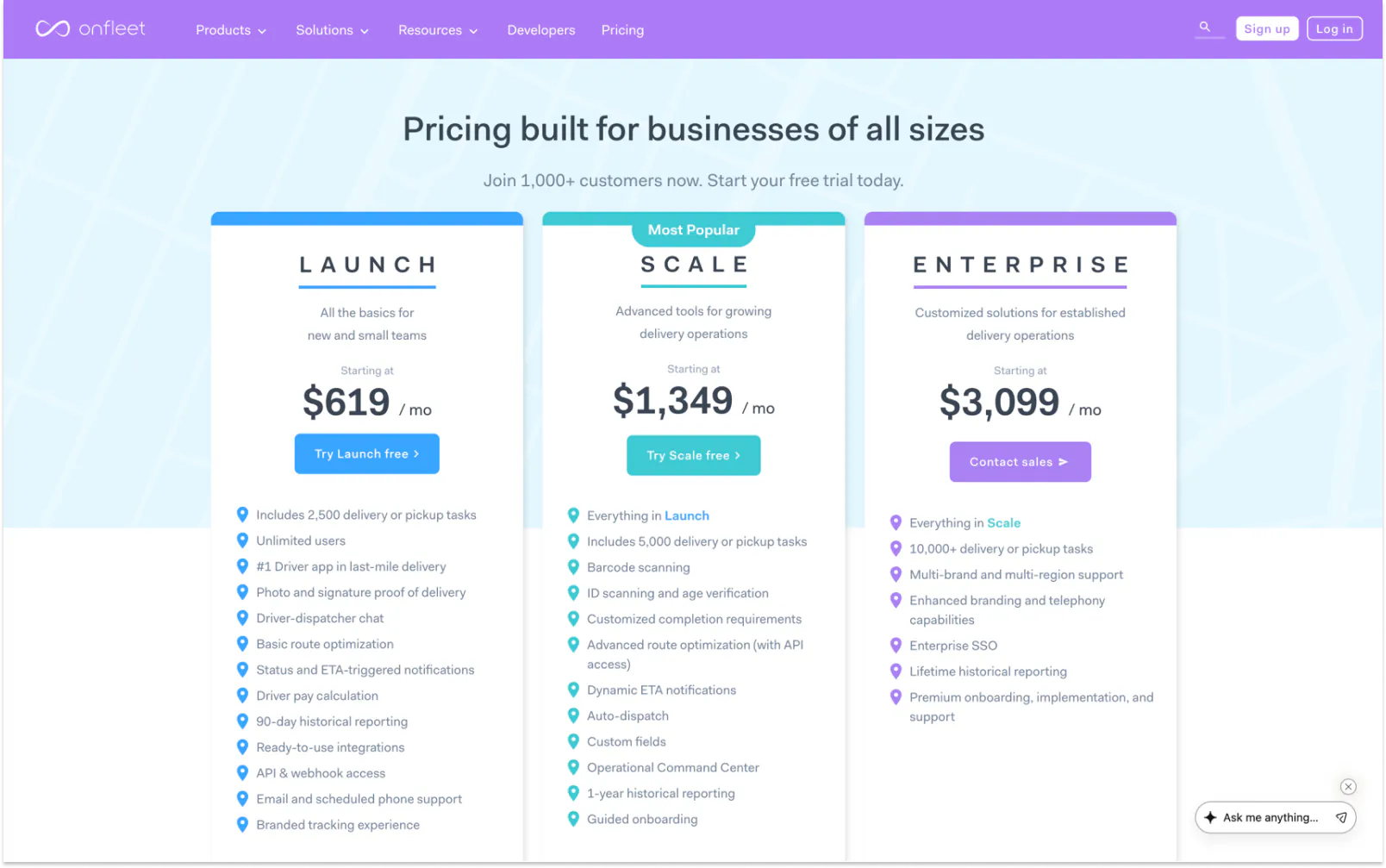
Onfleet's three published pricing tiers as of September 2026:
- Launch: $619/month for up to 2,500 tasks. Basic route optimization only. No barcode scanning, no age verification, no auto-dispatch.
- Scale: $1,349/month for up to 5,000 tasks. Advanced route optimization, barcode scanning, ID and age verification, auto-dispatch, dynamic ETAs.
- Enterprise: $3,099/month for 10,000+ tasks. Multi-brand and multi-region support, SSO, premium onboarding and SLAs.
There are three things to flag:
- Onfleet charges additional overage fees for tasks beyond your plan limits. They don't disclose specific overage rates on their main pricing page, but some sources suggest a rate of around $0.26 per completed task, with rates decreasing at higher volumes. You can track potential overage charges in your billing dashboard, but the lack of transparent rate disclosure makes cost planning more difficult compared to Routific's upfront per-order pricing.
- The tier jumps are steep — Launch to Scale more than doubles the bill, and Scale to Enterprise more than doubles it again. Businesses sitting just above a threshold end up paying for capacity they don't use.
- Advanced route optimization is only available from the Scale tier, so Launch customers at $619/month are running on Onfleet's basic routing.
The Courier Suite add-on for 3PLs costs another $299/month.
The free trial is 14 days.
Routific pricing

Routific's per-order pricing scales with delivery volume, not headcount or features:
- Up to 100 orders/month: Free.
- 101–1,000 orders/month: $150/month flat.
- Above 1,000 orders: A few cents per order, scaling down as volume grows. Starts at 15¢/order up to 2,000 orders, drops to 3¢/order above 20,000.
Every Routific plan includes the same route optimization algorithm, the same dispatcher tools, and barcode scanning. The 7-day free trial includes unlimited stops and full functionality — only SMS notifications are excluded, because SMS is billed through a paid third-party service.
Bottom line on pricing
For most growing local delivery businesses, Routific is substantially cheaper. A business doing 1,000 orders a month pays $150 on Routific versus $619 on Onfleet Launch — and on Launch, you're not getting advanced routing. A 5,000-order operation costs around $630 on Routific versus $1,349 on Onfleet Scale.
For enterprise operations that need multi-brand support, HIPAA compliance, or hybrid fleet orchestration, Onfleet's pricing fits a different use case — but at that scale, you're not really comparing the two platforms head-to-head.
Why Routific's route optimization and dispatcher tools are stronger
For local businesses planning delivery routes every day, route quality and dispatcher workflow are where the difference shows up.
Route quality directly affects cost per delivery. Tangled routes mean more fuel, more driver hours, more overtime. In our tests across platforms, there's up to 20% efficiency variation between algorithms.
Routific's approach

Routific has spent over a decade refining its in-house algorithm with the help of AI and machine learning. The algorithm is tuned for the realities of local last-mile delivery: multi-stop routes, tight time windows, logical sequencing that drivers will actually follow.
Routific takes into account historical traffic, so it builds routes that are more efficient than we could ever build. — Jackie Andrews, Demand Planning Manager, Walden Local
Routific is also built for ease of use — because dispatchers in local delivery businesses are operations experts, not software gurus. Unlike most route planning software, Routific shows dispatchers a live view of the whole day on both a map and a timeline. The editing tools are built to make the dispatcher's daily tasks as easy as possible:
- Drag-and-drop editing on the timeline or the map — move a single stop between drivers, or use the lasso tool to move whole clusters.
- Draw routes: A patented feature where dispatchers sketch a route on the map and the algorithm follows it. No other major platform offers this.
- Driver familiarity: The algorithm learns which drivers know each area best and suggests assignments.
- Copy and move routes across days for recurring runs.
Onfleet's approach

Onfleet markets its route optimization as "AI trained on 400M+ deliveries". The dispatcher interface uses a list view and map pins rather than a timeline, and on-the-fly edits — which most dispatchers make several times a day — involve more clicks. Advanced route optimization is only available from the Scale plan upward.
Onfleet's real dispatcher strength is auto-dispatch for on-demand workflows, where incoming orders are automatically assigned to the nearest driver. If that's the core of your operation, Onfleet is hard to match. If you're planning a day of batched stops in advance, Routific's tooling is faster.
Where Onfleet genuinely wins
Three areas where Onfleet is the better choice, regardless of business size:
- Regulated industries. HIPAA compliance for pharmacy, in-app age verification for cannabis and alcohol, chain-of-custody proof. Routific does not offer age verification.
- Hybrid fleet operations. Onfleet Connect gives access to a network of 150+ courier partners for overflow capacity, with unified analytics across your own drivers and outsourced ones. There's no equivalent in Routific.
- Courier and 3PL businesses. The Courier Suite's rate tables, automated invoicing, client portal, and driver pay calculation are purpose-built for delivery service providers. Routific doesn't target this segment.
Where Routific wins
Routific is for growing local delivery businesses running their own or contract drivers:
- Route quality. Human-friendly routes make for better driver compliance.
- Dispatcher workflow. Routific's route planning tools prioritise ease of use and is designed to make the dispatcher's life as easy as possible.
- Pricing that scales with your business. There are no feature gates between tiers and no sudden jumps. The per-order rate actually drops as volume grows.
- Barcode scanning. This is included at every plan tier, including free. Onfleet locks it behind the $1,349/month Scale plan.
- Customer support across every plan. Routific maintains a 98% customer satisfaction score with an in-house support team — not outsourced or tier-gated.
- Built to grow with you. Routific supports up to 50,000 stops per day. You won't outgrow the platform's capability, and the pricing won't suddenly triple because you crossed a threshold.
The Routific team has really good customer service. I'm always feeling connected and I can raise my hand if something doesn't look right. — Jackie Andrews, Walden Local
How do the driver apps compare?
Both platforms have mobile apps for iOS and Android with proof of delivery, photo capture, and live GPS tracking. Both are well-reviewed for driver usability.
Onfleet's app includes in-app chat between drivers and dispatchers, plus masked phone numbers that let drivers contact customers without sharing personal numbers, and barcode scanning and age verification on higher tiers. Routific's app is cleaner and faster for less tech-savvy drivers:
For dispatchers working with tech-impaired employees, this is a life-saver! The driver app is also attractive with a clean and intuitive UI. — David H, Capterra
How do Onfleet and Routific compare on APIs and integrations?
Onfleet integrations focus on enterprise and on-demand delivery workflows. Onfleet's API allows businesses to integrate seamlessly with various systems, such as online ordering interfaces, inventory and warehouse management systems. Key off-the-shelf integrations include Shopify, WooCommerce, order management systems, and supply chain tools designed for multi-brand operations.
Routific offers a native Shopify integration that can be accessed via the Shopify app store or directly within the Routific app — no development work required.
For businesses using WooCommerce, Magento, Zoho, BigCommerce, and other order management and CRM tools, Routific's two-way API handles custom connections.
Routific vs Onfleet for customer communications
Routific can automatically notify customers at four points in the delivery process:
- When a delivery is scheduled and the route is published
- When the driver is on the way
- When the delivery is completed, and
- When a delivery is missed.
Both email and SMS are supported — email is included on all plans; SMS is available at an additional cost that varies by country.
Dispatchers can customize the text of every notification and insert dynamic tags (customer name, ETA, order details) for each event. Every notification includes a link to Routific's Delivery Tracker, which shows customers a live ETA. Within 15 minutes of the driver's expected arrival, customers can watch their driver approach in real time, Uber-style. Proof-of-delivery photos are also visible in the tracker.
For most local delivery operations, Routific's customer communication setup requires no development work and no third-party tools.
Onfleet covers the same notification baseline, with a few additional communication features:
- In-app chat lets dispatchers message drivers directly without leaving the platform.
- Masked phone numbers allow drivers and customers to call or text each other without revealing personal numbers — useful for on-demand operations where ad-hoc driver-customer contact is common.
Onfleet's enterprise focus also extends to regulated delivery verticals like pharmacy and cannabis, where proof-of-delivery and communication requirements are stricter.
Who should choose Onfleet?
Onfleet is the right choice if:
- You operate at enterprise scale with multi-brand or multi-region delivery.
- You need HIPAA compliance for pharmacy delivery or age verification for cannabis or alcohol.
- You run a hybrid fleet, blending your own drivers with third-party couriers.
- You operate a courier business or 3PL and need client portals, rate tables, and integrated invoicing.
- You need on-demand auto-dispatch of incoming orders to the nearest driver.
- Your operation justifies the $619+/month minimum spend.
Who should choose Routific?
Routific is the right choice if:
- You run a local or regional delivery business — food distribution, meal kits, grocery, CSA, pharmacy, floral, or similar.
- You manage your own fleet or contract drivers, not outsourced courier networks.
- Route quality and dispatcher efficiency are top priorities, and you're tired of fixing tangled routes.
- You want pricing that scales with volume and doesn't punish you for growing.
- You value in-house customer support included at every plan tier.
How to test Routific and Onfleet with your own data
If you're still not sure whether Routific or Onfleet is the right choice for you, test both with your actual delivery data.
- Prepare a real stop list — a typical day's worth of deliveries with time windows.
- Add your drivers with realistic start locations and shifts.
- Run the optimization on both platforms. Look at the map. Would your drivers be happy following these routes?
- Edit a route — move stops, reassign, reschedule. See which platform handles it faster.
- Dispatch a test run end-to-end with a real driver.
- Contact support with a genuine question. The response speed and quality will tell you a lot.
Routific's free trial runs 7 days with unlimited stops and no credit card required. Onfleet's 14-day free trial gives you access to your chosen tier.
💡 Need a broader view? See our full comparison of route planning software or our Routific alternatives guide.
Frequently Asked Questions
Is Routific cheaper than Onfleet?

For most local delivery operations, yes — substantially. Routific starts free up to 100 orders/month and costs $150/month for 101–1,000 orders. Onfleet starts at $619/month for up to 2,500 tasks, with advanced route optimization only available on the $1,349/month Scale plan. A business doing 1,000 orders a month pays $150 on Routific versus $619 on Onfleet Launch.
Is Onfleet a good fit for small delivery businesses?
In 2026, not really. Onfleet's strongest features — hybrid fleet dispatch, multi-brand support, HIPAA compliance, courier network access — are aimed at large, complex operations. For a small or growing local delivery business running its own or contract drivers, most of Onfleet's capabilities are unnecessary, and the $619+/month floor is hard to justify.
How has Onfleet changed over time?
Onfleet used to sit in the mid-market as a go-to for growing local delivery businesses. Over the past few years it's moved upmarket, repositioning as a last-mile orchestration platform for enterprise customers. Its homepage now leads with Kroger, Pizza Hut, Starbucks, and Core & Main, and its strongest features target hybrid fleets, multi-brand operations, and regulated industries. Pricing has risen to match.
Does Routific support on-demand dispatch?
Not in the way Onfleet does. Routific is built for planning batches of stops across your own or contract drivers, not auto-assigning incoming orders to the nearest available driver. You can still re-optimize and adjust routes throughout the day as orders change. For true on-demand dispatch workflows — restaurants, same-day courier — Onfleet is the better fit.
Does Routific offer age verification?
Routific supports barcode scanning at every tier for order verification, but does not currently offer in-app ID scanning or age verification. If you deliver cannabis, alcohol, or prescription medication and need point-of-delivery age checks, Onfleet's Scale plan is built for this.
Can I switch from Onfleet to Routific?
Yes. Routific supports CSV import of stop lists in the standard format most operations already use, and the Routific support team helps with the transition. Businesses that have outgrown their starter tier on Onfleet — or are paying for enterprise features they don't use — often move to Routific to simplify pricing and get better route quality.
Which platform is better for food delivery?
It depends on the shape of your operation. For planned food delivery — meal kits, CSAs, local food distribution, grocery delivery from your own warehouse — Routific is generally the better fit: cleaner routes, stronger dispatcher tools, pricing that scales with volume. For on-demand restaurant delivery or multi-brand grocery operations blending in-house drivers with third-party couriers, Onfleet is built for that scale and complexity.
Is Onfleet good for e-commerce businesses?
Onfleet works well for e-commerce operations that need enterprise-scale delivery management, especially those running on-demand delivery or hybrid fleets. However, for most small businesses and mid-sized businesses with Shopify stores or recurring delivery models, Routific's streamlined approach and transparent pricing typically provide better value.
Which platform is more user-friendly, Onfleet or Routific?
Routific prioritizes ease of use with a user-friendly interface designed around practical delivery management needs. Onfleet offers more advanced modules, but the complexity can be overwhelming for operations that don't need enterprise-scale orchestration.

Onfleet Alternatives: Top Delivery Management Platforms Compared

Best Last Mile Delivery Software for Growing Businesses (2026)