Spoke Dispatch vs Routific: Which Delivery Management Software Is the Better Fit?

How do Spoke Dispatch and Routific stack up on pricing, route quality, and features? We break it down so you can decide fast.

- Spoke Dispatch (formerly Circuit for Teams) is a user-friendly route planner built primarily for courier and parcel delivery. Routific is delivery management software designed for planned local delivery operations like food, beverage, and retail.
- Routific produces significantly cleaner, more efficient routes — up to 15% shorter distances with far less overlap between routes.
- Routific's dispatcher tools — including a timeline view, drag-and-drop editing, and a draw route feature — give dispatchers much more control after optimization. Spoke Dispatch has limited route editing.
- Both use per-stop pricing, but Routific's cost per order decreases with volume while Spoke Dispatch's increases — making Routific more cost-effective as you grow.
- Both include standard features: real-time GPS tracking, proof of delivery, barcode scanning, customer notifications, and free driver apps for iOS and Android.
- Spoke Dispatch has a popular Package Finder feature and strong delivery analytics.
- Routific has stronger route optimization, better dispatcher tools, and consistently higher-rated customer support.
Who is this article for?
If you're comparing Spoke Dispatch and Routific, you're probably a dispatcher, delivery manager, or operations manager at a small- to medium-sized business that delivers locally. Maybe you're running a meal prep service, a grocery delivery company, a farm box CSA, a brewery, or a courier operation — and you need route planning software that can handle multiple delivery drivers, multiple routes, and hundreds or thousands of stops every day.
Both Spoke Dispatch and Routific are well-reviewed delivery management software platforms with similar core features. But they have different strengths, and they're designed for different kinds of delivery operations.
💡 Note: Spoke Dispatch was formerly known as Circuit for Teams. The company rebranded in late 2025. If you've seen reviews or comparisons referencing Circuit for Teams, they're talking about the same product. For a broader comparison of the different route optimization software options, see our full Spoke Dispatch review and alternatives.
Pricing comparison
The biggest structural difference between Spoke Dispatch and Routific is how pricing scales as your business grows.
Routific uses a per-order pricing model where the cost per order decreases with volume:
- First 100 orders every month: Free
- 100–1,000 orders: $150/month
- Above 1,000 orders: A few cents per order, starting at 15c and scaling down to 3c per order above 20,000 orders/month
Spoke Dispatch uses a tiered pricing model where features and data history are gated by plan:
- Starter: $125/month for up to 1,000 stops, then 4c per stop. 30-day data history. Limited to 1 dispatcher and 5 drivers.
- Premium: $200/month for up to 2,000 stops, then 6c per stop. 1-year data history. Custom branding and advanced notifications.
- Expert: $1,000/month for up to 12,000 stops, then 7c per stop. 5-year data history. Personalized onboarding.
The key difference: Routific's per-order cost goes down as you grow (from 15c to 3c). Spoke Dispatch's per-stop overage cost goes up at higher tiers (from 4c to 7c). This means that as your delivery volumes increase, Routific gets relatively cheaper and Spoke Dispatch gets relatively more expensive.
At lower volumes, the two platforms are comparable in price. At 1,000 stops per month, Spoke Dispatch costs $125 and Routific costs $150. But as volume grows, the gap shifts in Routific's favor — and Routific doesn't restrict features, drivers, or dispatchers at any level.
💡 Note: Routific switched from per-driver to per-order pricing in mid-2024. Some competitor websites and review sites still cite our old pricing. The current pricing is always at routific.com/pricing.
Feature comparison
Both platforms include all the standard features you'd expect from delivery management software: route optimization, a mobile driver app, real-time GPS tracking, customer notifications, proof of delivery with photos and signatures, barcode scanning, and spreadsheet upload.
Here's where they differ:
Route optimization quality
This is where the two platforms diverge most sharply.
Routific's route optimization algorithm is built in-house by a dedicated data science team, and it's been the company's core focus for over a decade. The algorithm uses AI and machine learning to produce delivery routes that are both mathematically efficient and driver-friendly — avoiding the tangled, criss-crossing "spaghetti routes" that plague many route optimization platforms.
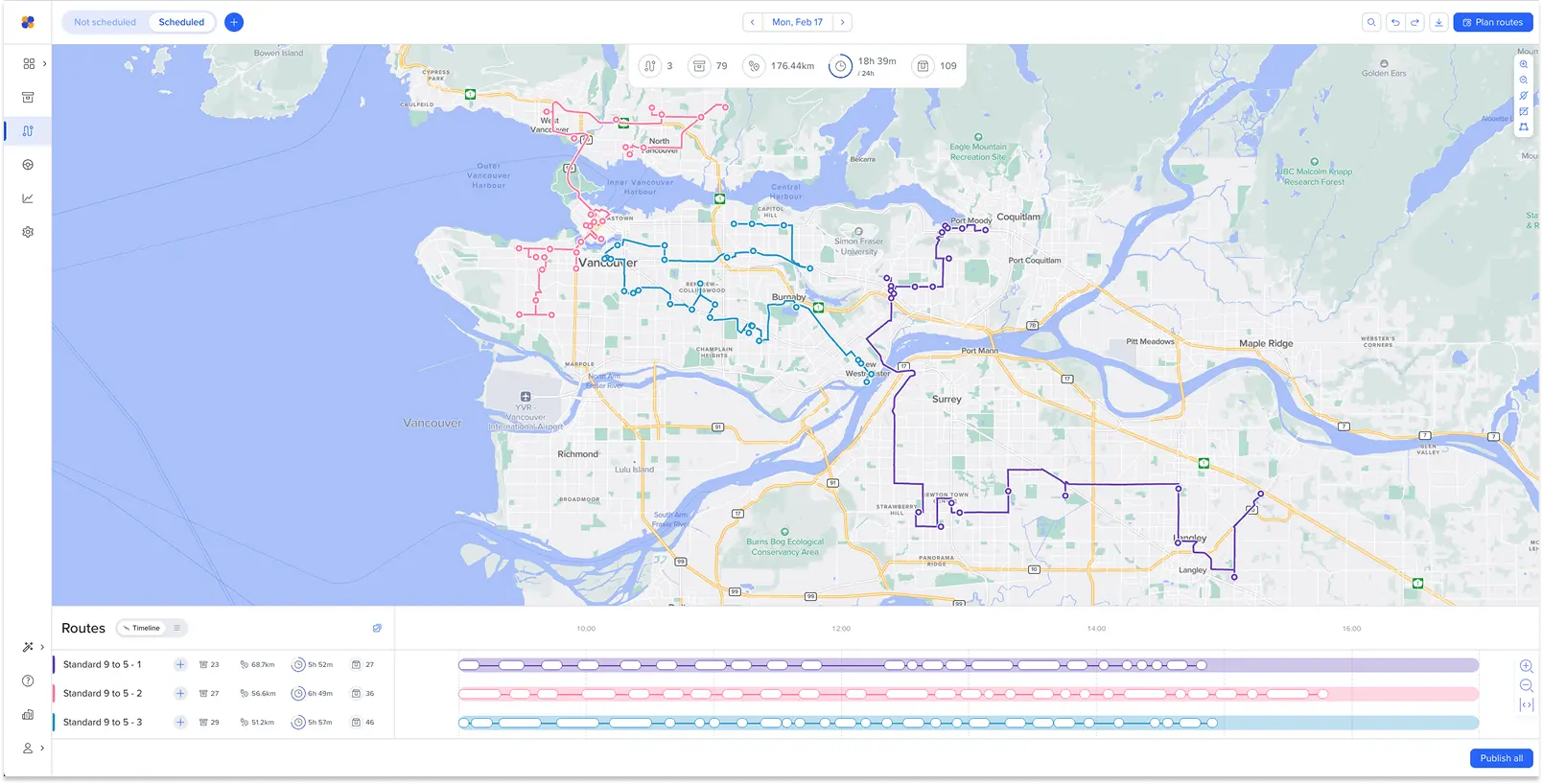
In our tests using real delivery data in Vancouver, Routific's optimized routes were up to 15% shorter than Spoke Dispatch's, and significantly cleaner. On a typical 100-mile daily route, that's 15 miles saved — roughly 30–45 minutes of drive time and several dollars in fuel.
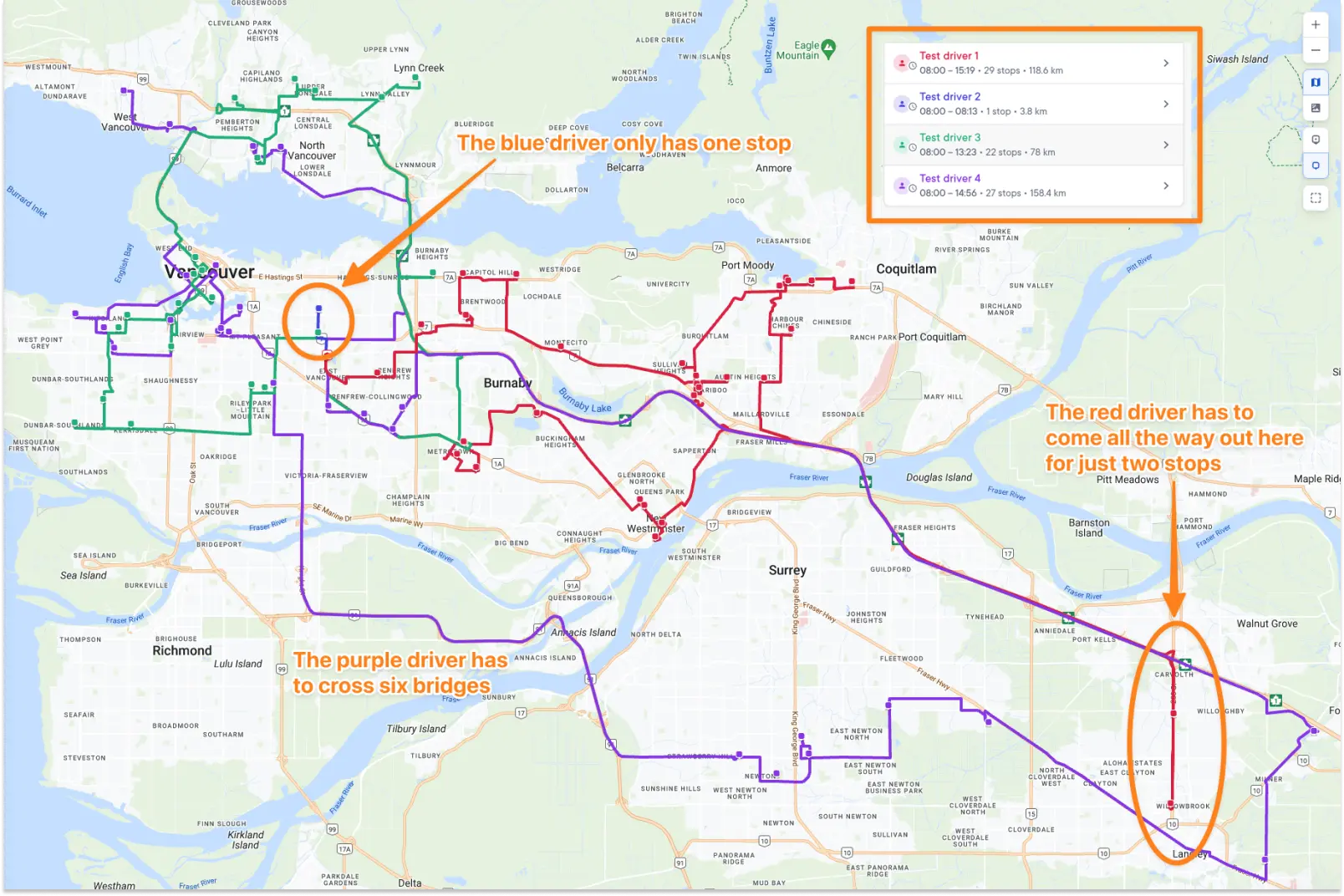
Spoke Dispatch's route optimization, by contrast, produced a lot of messy, overlapping routes in our testing. This is particularly notable because Spoke markets itself as a driver-first platform — but tangled routes that force drivers to criss-cross each other's territories create a genuinely poor driver experience.
"The ease of use, simplicity, and customer service is second to none. I have tried and demoed every routing tool out there and none come close to Routific." — Morgan H, SMB CEO
Dispatcher tools and route management
If you're a dispatcher or route manager juggling multiple routes and drivers every day, the tools you use to view, edit, and manage those routes matter just as much as the optimization itself.
Routific offers a combined map and timeline view that shows all routes for the day at a glance. Dispatchers can:
- Drag and drop stops between routes on both the map and the timeline
- Use the Draw Route feature to tell the algorithm what they want routes to look like
- Batch-select and move groups of stops using a lasso tool
- See real-time progress across all routes simultaneously
These tools matter because no algorithm is perfect, and it sometimes takes a human to confirm the most efficient route. Every experienced dispatcher knows their city's quirks — the bridge that backs up at 4pm, the neighborhood where parking is impossible on Tuesdays. The ability to quickly fine-tune routes before dispatch is essential to a smooth delivery process.
Spoke Dispatch doesn't offer a timeline view, and its route editing options are limited. You can see multiple routes on the map, but there's no easy way to move stops between routes or see overall distance and time metrics for the day. This makes it harder for dispatchers to spot problems and make adjustments — particularly when managing five, ten, or twenty routes simultaneously.
"Overall the multiple clicks to add a stop, make changes to a route is a bit cumbersome. It would be nice to streamline that process." — Derek N, midmarket retail manager
Customer experience: notifications, tracking, and ETAs
Both platforms let you keep customers informed — but the details differ.
Customer notifications. Routific and Spoke Dispatch both support automated email and SMS notifications that tell customers when to expect their delivery. Email notifications are free; SMS notifications are charged separately through third-party providers.
Live tracking links. Both platforms generate a live tracking page that you can share with customers, so they can see their driver's real-time location and ETA on a map. This is a big deal for the customer experience — it reduces "where's my delivery?" calls and lets customers plan their day around the delivery window.
ETA accuracy. Routific's algorithm uses historical traffic data to predict travel times, which means ETA estimates tend to be more accurate — especially in cities with predictable traffic patterns like rush-hour bridge congestion or school-zone slowdowns. More accurate ETAs mean more reliable customer notifications, fewer missed deliveries, and a better delivery experience overall.
Driver management. Routific's timeline view doubles as a driver management tool: dispatchers can see at a glance which drivers are ahead of schedule, which are falling behind, and where each driver is on their route. This makes it easy to reassign stops or adjust routes in real time if something goes wrong. Spoke Dispatch shows driver locations on the map, but without a timeline view it's harder to monitor progress across the full fleet at once.
Where Spoke Dispatch is stronger
Spoke Dispatch has genuine strengths that make it the better choice for certain use cases:
- Ease of use and fast setup. Spoke's browser-based dashboard is impressively simple to learn. If you're a very small business where one person handles route planning, dispatch, and everything else, Spoke's simplicity is a real advantage.
- Driver mobile app and Package Finder. Spoke's mobile app grew out of a popular standalone driver app, and it shows. The Package Finder feature — which lets drivers tag packages by position in the vehicle during loading — can save meaningful time at each stop.
- Integrations. Both Spoke and Routific offer native integrations with Shopify. Spoke also has a native integration with Zapier, making it easy to connect to e-commerce platforms and automate workflows without custom development. Routific's Platform API offers similar functionality but requires more technical setup.
- Delivery analytics. Spoke Dispatch provides built-in reports for tracking failed deliveries, on-time delivery rates, and cost per delivery. These analytics are gated by plan tier — Starter only provides 30 days of data history, while Expert provides 5 years.
"What I appreciate most about Spoke Dispatch is its straightforward and user-friendly design. It simplifies route planning, load assignment, and real-time tracking, which helps our team remain organized and operate more efficiently." — G2 reviewer
Where Routific is stronger
- Route optimization quality. Routific consistently produces shorter, cleaner routes with less overlap, and more accurate ETAs. For delivery businesses where fuel costs, driver hours, and on-time delivery rates directly affect profitability, this is the single biggest differentiator.
- Dispatcher and route management tools. The combined map-and-timeline view, drag-and-drop editing, Draw Route, and batch editing tools give dispatchers the control they need to manage complex daily operations efficiently.
- Pricing that scales with growth. Routific's all-features-included model means you'll never hit a paywall for proof of delivery, analytics, or additional dispatchers. And the decreasing per-order cost rewards growth rather than penalizing it.
- Routing Engine API. Routific's standalone Routing Engine API allows businesses to embed route optimization directly into their own systems — a rare offering that most competitors, including Spoke Dispatch, don't provide.
- Customer support. Routific maintains a 98% customer satisfaction rate with an in-house support team. This is consistently mentioned in user reviews as a major differentiator.
"The team behind this service is just awesome. They are knowledgeable, responsive, and genuinely invested in helping their users succeed." — Alyssa S, retail CEO
Different platforms for different businesses
Spoke Dispatch and Routific are both good delivery management software — but they're built for different kinds of operations and business needs.
Spoke Dispatch is a better fit if you're a small courier or parcel delivery business where drivers operate fairly independently and you want a simple setup with minimal dispatcher oversight. Spoke's positioning as a courier-first platform is reflected in their features, marketing, and customer base.
Routific is a better fit if you're a food delivery company, brewery, meal prep service, CSA, or retail business that plans multiple routes each day and needs precise dispatcher control. Routific's route optimization quality and editing tools make a noticeable difference when efficiency, driver experience, and delivery accuracy directly affect your bottom line.
Neither platform supports on-demand delivery (use Onfleet or a service like DoorDash Drive for that) or multi-day routing (try OptimoRoute). For a broader comparison, see our guide to the best route planning software for delivery businesses.
The verdict
For most small- to medium-sized delivery businesses — especially those in food, beverage, or retail — Routific is the stronger choice. The route optimization quality is meaningfully better, the dispatcher tools are more capable, the pricing scales more favorably, and the customer support is consistently excellent.
Spoke Dispatch is a solid option for smaller courier operations that prioritize simplicity and a driver-first mobile experience. If your drivers work independently and your routing needs are straightforward, Spoke can get you up and running quickly.
The best way to decide? Test both platforms with your own delivery data. Route planners can behave differently depending on your geography, stop density, and delivery patterns. Try Routific free for 7 days — no credit card needed.
Frequently Asked Questions
Is Spoke Dispatch the same as Circuit for Teams?

Yes. Spoke Dispatch was formerly known as Circuit for Teams. The company rebranded in late 2025, but the product is the same. Reviews and comparisons that reference Circuit for Teams are talking about the same software that is now called Spoke Dispatch.
How much does Spoke Dispatch cost compared to Routific?
At low volumes the two are comparable: Spoke Dispatch starts at $125/month for up to 1,000 stops, while Routific costs $150/month for up to 1,000 orders. As volumes increase, Routific gets cheaper per order (down to 3¢ above 20,000 orders/month), while Spoke Dispatch's per-stop overage cost increases at higher plan tiers (from 4¢ to 7¢). Routific also includes all features at every pricing level, with no feature gating.
Does Routific have barcode scanning?
Yes. Routific added barcode scanning in late 2025. Drivers can scan packages at the door to confirm the right items are being delivered to the right customer, and dispatchers get a real-time audit trail of each scan. Barcode scanning is included at no extra cost.
Which is better for courier businesses: Spoke Dispatch or Routific?
Spoke Dispatch is specifically positioned for courier and parcel delivery operations, with features like Package Finder and native Shopify and Zapier integrations. Routific is a better fit for planned local delivery businesses — like food, beverage, and retail — that need strong route optimization and dispatcher tools. Both platforms handle multi-stop route planning and delivery management, so the best approach is to test both with your own data.
Does Spoke Dispatch have a timeline view?
No. Spoke Dispatch displays routes on a map but does not offer a timeline view. Routific's timeline view shows all routes for the day in a single view, with real-time progress updates and drag-and-drop editing, making it easier for dispatchers to manage multiple routes and drivers simultaneously.
Spoke Dispatch Route Planner: Review and Alternatives

Best Route Planning Software For Last Mile Delivery Businesses in 2026